
Growing up, Zack Youcha inherited a special gift from his grandfather: an awe for technology and the world of sound recording. As many in his generation, Youcha’s grandfather recorded all sorts of things: conversations at the dinner table, holiday prayers, television programs … Among these heirlooms of modernity were tapes of his own mother singing Pesah songs. Zack never met his great-grandmother and, magically, was suddenly able to hear her voice.
That moment of discovery sparked Zack’s interest in the many pasts he might never encounter and the idea that with a little ingenuity and modern science, bits of the present, often flowing through the vortex of the world’s upheavals, could be put in a treasure box for future listeners.
Sound is indeed one of the most mysterious aspects of historical research, one that punctually eludes scholars and intrigues artists who need to resort to imaginative tricks in order to capture a possible soundscape, a pronunciation, an inflection, a trope, a melody from a faraway past.
While technical reproduction is not the real thing and can only partially compensate for the passage of time, it offers one of the most fascinating possibilities of our era.
Inspired by his personal experience, in 2025, Zack Youcha founded Music is Culture, or MiC, a nonprofit organization dedicated to helping people worldwide conduct and publish their own music preservation efforts—particularly works related to music of cultural significance that might otherwise be lost, destroyed, or forgotten. His projects span from southeastern Zimbabwe and central-western Mozambique to Armenian, Yezidi, and Iraqi music.
Zack’s journey started with the discovery of his great-grandmother’s Sephardic songs and expanded to a web of traditions and memories, moving between past and present and across geographic regions. In the process, he began to see a broader horizon, a choral reality that personal history helped imagine but could not contain alone.
As one of the dwellers at Bookhouse, Youcha shared with us some ideas of how the Music Room will begin to take shape.
“A few years ago, I worked with the UN on a project to preserve regional Sephardic kantikas – folk songs with Ladino lyrics whose melodies belonged to all the peoples of the former Ottoman Empire and beyond. I played these songs to a room full of diplomats who, on paper, belonged to countries in conflict with each other. The sounds were familiar to all, but the language carried no nationalism. Ladino became a medium for people to enjoy the music of their homeland without grappling with the politics that pervade life at the United Nations. Their social barriers broke down. People from alleged “enemy” countries became dance partners: laughing and spinning around the room, delighting in the kinship of their cultures.
With the opening of the Music Room, I hope to bring that spirit into a more accessible space. Music Room takes its shape from a wheel with Sephardic music at the center, and spokes reaching out to all the peoples of New York. As I have seen time and time again, in this tradition, shaped by the mobility of the Mediterranean and Ottoman worlds, music ties cultures together. It starts dialogues that grow into unexpected community connections. With a dedicated space, we will start conversations and build bridges.
Work at the Music Room will be both inward and outward-looking. It will connect to other researchers and organizations. At the same time, we will digitize vast collections of archival recordings from the American Sephardi Federation and share them through our online radio; host workshops on Sephardic musical styles, from folk to liturgical; build musical connections between older and younger generations; and teach communities the practical skills necessary for music to live on and flourish.”
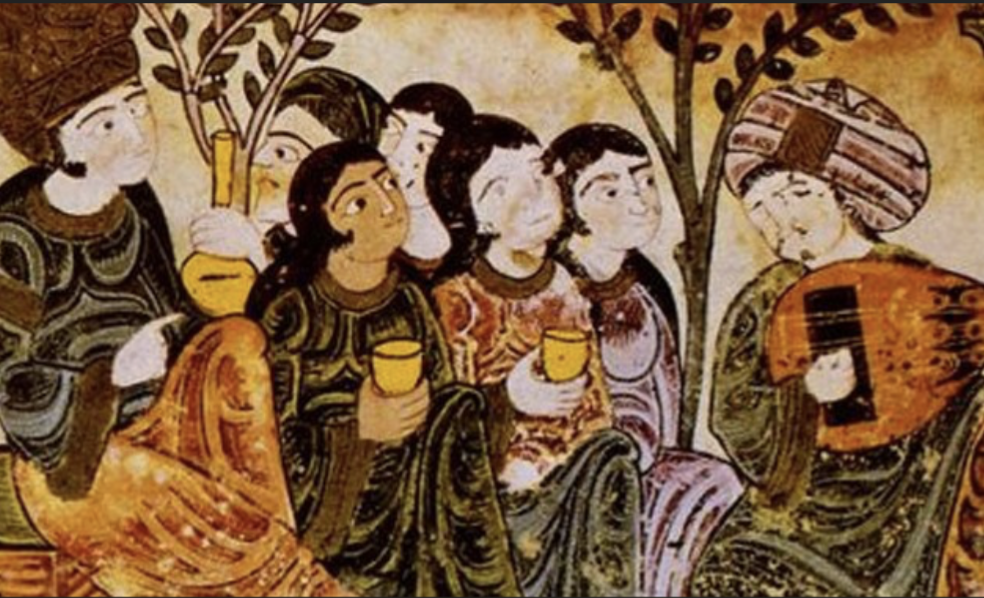
Image: History of Bayâd and Riyâd (“Hadih Bayâd wa Riyâd”), Maghrebi or Andalusian manuscript. Vatican Apostolic Library, Ms. Ar. 368., 13th century