
We are pleased to announce the launch of the Music Room, which will begin to function on September 22nd, 2026. During the past two years, Bookhouse has become home to students and the public for classes, seminars, roundtables, concerts, and film screenings dedicated to the Jewish experience in the Mediterranean and former Ottoman lands. Inspired by our Board member and Auschwitz survivor Stella Levi, we have set up a Diwan room for poetry readings, a bookstore specializing in Sephardic and Italian history, and a fully functioning print shop where a group of young artists prints in Hebrew, Ladino, English, Judeo-Arabic, and other languages.
The Music Room emerged from a collaboration with musicologists, researchers, and practitioners Zack Youcha and Daniel Elias. It will expand the scope of Bookhouse to Sephardic, Mediterranean, and Ottoman music and liturgy. It will function as a preservation lab for ASF, offering music classes and workshops. The room will house a Radio that will give access to the treasures of the Sephardic tradition retrieved from the ASF’s vast sound archive. As we proceed in our work in the ASF stacks, we have identified a large collection of audio tapes and long-playing records, as well as several valuable musical instruments of Ottoman and Persian origins. A considerable portion of this material comes from the Sephardic Home for the Aged and will be made available anew to younger generations and to many elderly people who can enjoy the sound and memory of their musical traditions. Over the course of 2027, we plan to index the ASF sound archive, digitize a selection of tapes, produce monthly radio segments, and host classes, workshops, and performances. The team will also restore the collection of traditional Ottoman and Persian instruments kept in the ASF archive and currently not playable, and will expand the collection of instruments.
Music is one of the most fundamental forms of expression that all cultures share and that, like other religions, Judaism places at the center of its practice. As emblematically represented by King David and his harp and psalms, words are chanted, and music is the place on which prayers and festive songs rest. As an intergenerational space, the Music Room will first and foremost reconnect the Jewish tradition to musical practice.
The project seizes a rare opportunity to develop a multi-ethnic musical community with Sephardic songs at its core. Of all the Jewish traditions, the Sephardic world at large is the one that has most intensely kept music at its center. Moreover, it provides a time capsule for the extraordinary richness of the Arab, Byzantine, and Italian musical traditions that have been incorporated into its practices over many centuries. Several magnificent archives are available to the team of the Music Room, the most important of which are the sound archive of the American Sephardi Federation and the sound archive that the Leo Levi Foundation is preserving with support from Centro Primo Levi (www.jewishitalianmusic.org).
Much of the ASF’s invaluable musical collection is recorded on tape. This fragile medium severely degrades over time. The tapes are already decades old and in dire need of digitization and updated conservation. Each recording captures a different moment in time in our world that, if not preserved, will be lost forever. Recordings include famous cantors singing prayers and piyyutim as well as anonymous, untrained musicians singing kantikas during pasatiempos. Together, these tapes make a mosaic of the Sephardic experience in the Americas and beyond. Like the music collected by Alan Lomax and Leo Levi, this sound archive can play a part in contemporary musical practices, within and without the Jewish world.
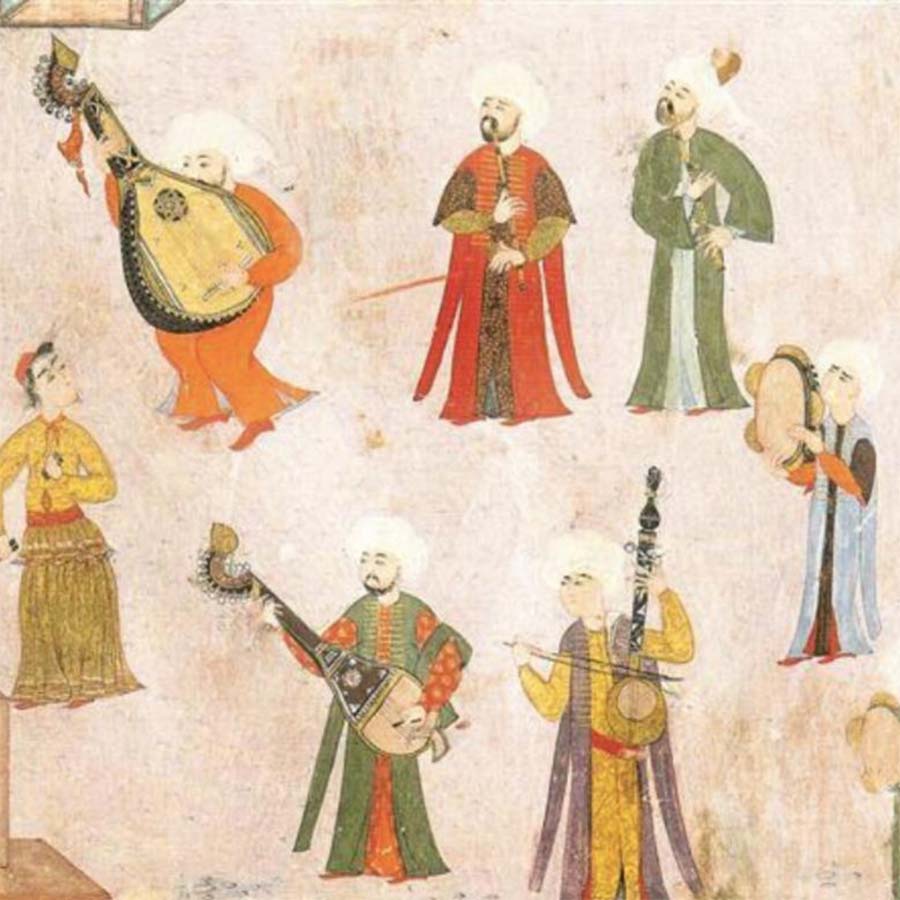
Image: The Surname-i Hümayun (‘Book of the Imperial Circumcision Festival’), circumcision celebration of Prince Mehmed, son of Sultan Murad III, 1582