
Embroidery, Monsters, and the Threads between Women in Morocco and Italy
Event Details
Join Elya Assayag for a conversation-workshop on her work on the history of Moroccan embroidery and the labor of tracing the past through one of the most ancient arts, largely practiced by women. Reservation is required: rsvp@primolevicenter.org
Embroidery is a powerful tool. It can be easily carried around and circulated from place to place. Thanks to its unique qualities, it tells stories that cannot be told in words.
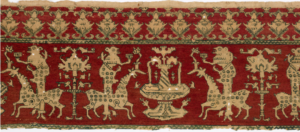
This talk will explore one of the unspoken stories told by embroideries in Morocco and Italy. The embroidery of Azemmour, a small town on Morocco’s Atlantic coast, stands out with its unique style, which differs from the geometric shapes of other Moroccan embroidery styles. Azemmour embroidery features birds, women, dragons, and monsters. Join us in this talk to trace the history of this unique embroidery. From 14th-century Assisi, Italy, to the 15th- and 16th-century expulsion of Jews and Muslims from the Iberian Peninsula to Morocco, we will explore how women, the primary creators of these remarkable embroideries, communicated with one another without words across the Mediterranean. Yet embroidery enables us to do much more. By exploring the circulation of embroideries across the Mediterranean, we can gain a better understanding of how nonverbal communication functioned in the past and continues to influence our present.
There is a phrase in Moroccan Arabic (Darija) that describes the situation where women get together to work and talk: ḥadith wa-maghzel حديث ومغزل. This phrase was originally used to describe what happened when women sat down together to spin yarn and weave, maghzel مغزل meaning a spindle. Today, it is used more broadly to describe the special bond that is formed between people when doing crafts, but also when cooking, walking together, or doing any other activity, while also speaking with each other.
During the talk, you will have the opportunity to closely examine embroideries from the American Sephardi Federation’s collections and experiment with basic embroidery stitches.
Bring your own embroidery to enrich the discussion and embroider during the talk!
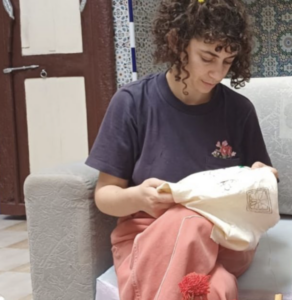 Elya Assayag is currently finishing her Ph.D. in history at Columbia University. Her research focuses on the history of women and embroidery in Morocco during the 19th and 20th centuries. Through her study of embroidery, she explores the operations of imperial and colonial powers in North Africa, as well as the shifts in knowledge and aesthetic trends carried by women. In her research, Elya combines archival research, material analysis, oral history interviews, and learning the craft itself. This “making and knowing”/ “knowing by making” approach enriches our understanding of those who left no written sources and were marginalized in historical narratives.
In her free time, Elya volunteers with asylum seekers and refugees and at her neighborhood food pantry.
Images: Maroccan embroidery workshop: creation.tameslouht@gmail.com; Band (Morocco), 18th century, silk on linen, Cooper Hewitt collection (1954-108-1)