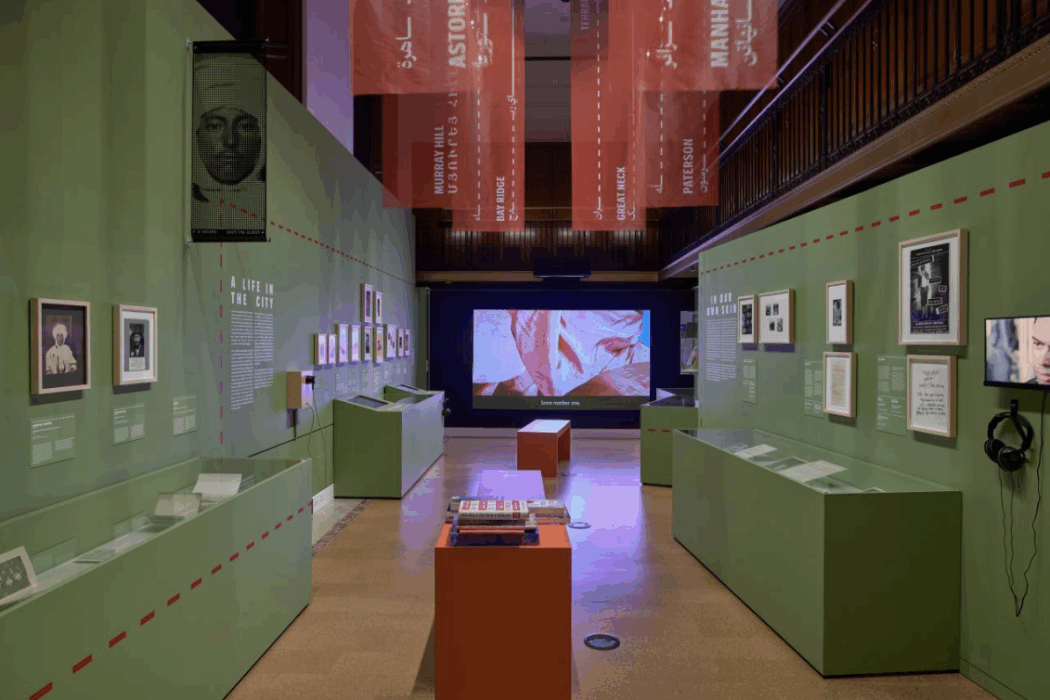
Niyū Yūrk: Middle Eastern and North African Lives in the City was a temporary exhibition at the New York Public Library (NYPL) Stephen A. Schwarzman Building, running until March 8, 2026. Curated by Hiba Abid, it explored the complex history of immigration from the Middle East and North Africa (MENA) to the United States, spanning from the turn of the 20th century to the present.
The exhibition traced a history marked by both turbulence and vibrancy—assimilation, persecution, music, art, literature, journalism, food, photography, and student activism. Organized into three main sections, the first, Roads to New York, highlighted the initial significant wave of immigration from the Middle East in the late 19th century, primarily from the Ottoman territory known as Greater Syria (modern Syria, Lebanon, Palestine, Israel, and Jordan). Artifacts included an Educational Guide for Syrian Students in the United States, published by the Syrian-American Press in 1921, alongside other guidebooks for English language learning and citizenship. The next section, A Life in the City, focused on the political, creative, and cultural contributions of these immigrants to New York. Presses and magazines provided writers a platform to reach wider audiences, transforming the city into a major center for Arab literature. Notably, the first Arabic linotype machine was developed in New York, influencing Arabic literature worldwide and underscoring the reciprocal relationship between New York and the MENA regions—far from a simple, one-way narrative of immigration. The final section, In Our Own Skin, shared the stories of individuals who resisted stereotypes and xenophobia, particularly during periods of intensified prejudice such as the 1967 Arab-Israeli War, the Gulf War, and 9/11.
But beyond the photographs, guidebooks and manuals, magazines, and other objects of material history, what makes it especially compelling is that this exhibition at the NYPL is also about itself. It’s a story of the Library, archives, and their evolving role in the community as public institutions.
A photograph hangs on the wall. In it, staring back in black-and-white, is a man in a suit, his tie crooked to one side, black-bearded, donning a black hat. Beneath him a type-written caption reads:
ARMENIAN JEW – ELLIS ISLAND 1926
This Armenian Jew probably left his native land to escape the Turkish persecution of the post-war period. His beard is typical of that worn by the Orthodox Jews of Europe and the Near East.
Photo-study by Lewis W. Hine
And immediately below that caption, another:
YEMENI JEW – ELLIS ISLAND 1926
The description below this second caption informs us that, despite his well-intentioned series of portraits that sought to humanize immigrants in the eyes of the American public, the photographer Lewis Hine had misidentified and misrecorded many of his subjects. This photograph of Rabbi Shalom Haif Nadoff was mislabeled by the Library until 2013, when the error was amended because the subject’s family recognized him in the picture. The end of the new description says how “his belated identification speaks to the ongoing need for correcting archival descriptions in libraries and restoring fuller narratives to those long left as anonymous.”
I was struck by the way the exhibition foregrounded the Library’s own history as an archival institution. In my conversation with the curator, Abid spoke to me about the intention behind retaining some of these outdated original descriptions as part of the display. This contextualization layers the exhibits with a weight of history and nuance such that this Yemeni Jew, and others like him, are not the only objects on display; so too are the attitudes, priorities, and documentation practices of the time. An exhibition about exhibition, and an archive’s relationship to the community it serves. Discussing the physical space, Abid recalled initial frustrations with its size and the presence of shelves lining the ceilings, preventing a level of verticality, but she grew to appreciate the effect of emphasizing the setting as a library, not a museum. And this sentiment is felt throughout the project. More than just visual stimuli on white walls, there is a discussion of why the Library has these materials, how they’ve been acquired, and what they have been and continue to be used for.
This all speaks to Hiba Abid’s intention with the exhibition and underlying attitude towards the role of history in the public sphere. There are natural frustrations that can arise for someone in the academic historical world, which can at times feel isolated from the world going on outside. What Abid’s project does here is demonstrate the role that an archive and library can serve in public life. This exhibition is full of objects that are extensions and reflections of the societies that produced them, and through this exhibition, can continue to assume a public function.
Another initial difficulty was sourcing and locating materials from within the NYPL archives. The curator explained that due to misrecording and mislabeling, it was initially quite difficult to have a good sense of what they even had. Solving this problem involved Abid realizing that, to some extent, she had to think like an early 20th-century Orientalist; get in a certain headspace and use a certain vocabulary to realize how older materials were more likely to be labeled and organized, based on older attitudes at the time and the different functions these archived materials served. A photograph from somewhere between 1902 and 1913 is titled and described:
A GROUP OF IMMIGRANTS, MOST WEARING FEZZES, SURROUNDING A LARGE VESSEL WHICH IS DECORATED WITH THE STAR AND CRESCENT SYMBOL OF THE MOSLEM REGION AND THE OTTOMAN TURKS.
The updated description warns us that probably few, if any, of the subjects were turks, or wearing Fezzes.
The very presence of what is there that has been photographed and archived, and the absence of what isn’t, is a testament to how institutions like the NYPL are, in part, reflections of evolving attitudes towards the MENA communities of New York. The kinds of photographs that represent the various time periods give insight into the roles of these minority groups in the public imagination.
A photograph in another section of the exhibition is titled:
THE ‘KING TUT’ EXTRAVAGANZA AT CLUB IBIS (NYC)
[1978]It features seven women around a man costumed as the pharaoh Tutankhamun, all in poses and makeup and outfits in line with what you’d expect to see if you were at a place called Club Ibis in the 1970s watching something called ‘The King Tut Extravaganza’. The description of another photograph, undated but likely from a similar time, talks of how a hybrid style of music developed in nightclubs, which the musician Eddie Kochak called Ameraba, “music with Oriental flavor, geared to the American ear.”
“…Kochack is pictured with a group of belly dancers, all wearing costumes that might underscore this sense of exoticism.”
Finally, there hasn’t been a time from the first waves of MENA migration to New York to today, that this exhibit wouldn’t have had a pressing significance – but today really does seem like a moment of particular relevance. In the time since I visited the exhibit, a few days before speaking with the curator and writing this article, Israel and the United States have propelled a military escalation with Iran, the consequences of which hardly a country in the Middle East has been spared. To the east, Pakistan wages war against Afghanistan. All this amidst Israel’s massacre of the Palestinian people that rages on into its third year, with the moral and material blessing of the United States. And New York, for what it’s been worth, has been a part of the global public response to what has taken place in Gaza and the West Bank – new chapters in a long history of a city and its political relationship with its MENA communities that stretches back to September 11th 2001, and even further, 100 years ago. The work of Hiba Abid and her exhibition spoke of yesterday as much as it does today, and no less tomorrow; there is a timelessness to these stories and dynamic forces of inclusion and exclusion at work.
But the story Abid wants to tell isn’t one of statistics and large geopolitical arenas, but rather the stories from which these numbers are born. Personal stories of people and their lives in the city. The exhibition doesn’t have a strong ideological narrative because Abid didn’t go into this project with a pre-existing one she wished to communicate. Rather, when I asked her about her initial vision, she spoke of how the point was to allow these people and objects to speak their own stories and surface above archival shelves to the public eye.