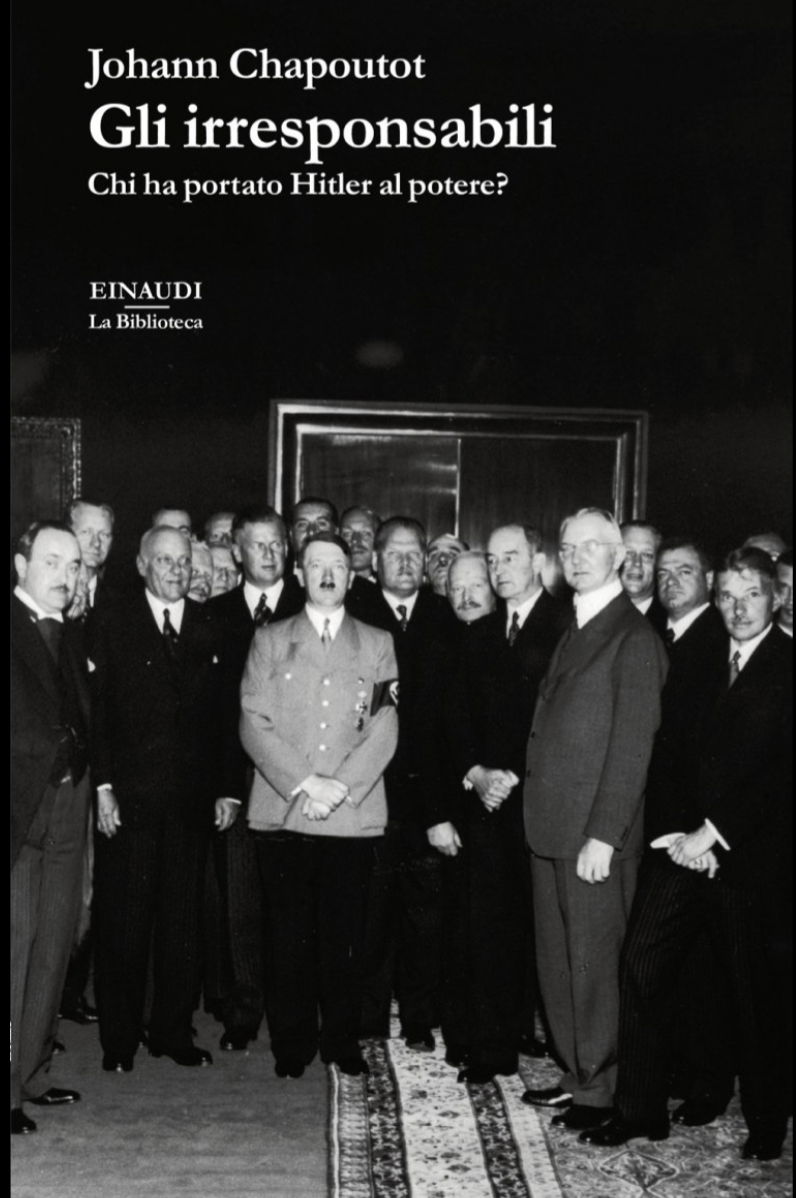
The Irresponsible. Who Brought Hitler to Power? by Johann Chapoutot, published in Italian by Einaudi
Published by the author’s permission from the Italian original. Marco Fioravanti is Professor of History of Medieval and Modern Law and History of Political Institutions at the University of Rome “Tor Vergata,” where he coordinates the PhD in Public Law Studies. He was Director of Research at the Collège International de Philosophie in Paris and a member of the scientific committee of the Ferruccio Parri National Institute. His publications include: The Normative Powers of Government (2009), The Prejudice of Color (2012), Slavery (2017), and To Control Power (2020). He collaborates with Alias, a cultural magazine of the newspaper Il Manifesto.
Johann Chapoutot teaches Contemporary History at the Sorbonne, Paris. He is the author of Free to Obey, Europa Editions, 2023, The Law of Blood: Thinking and Acting as a Nazi (Belknap Press, 2018), and Greeks, Romans, Germans: How the Nazis Usurped Europe’s Classical Past (University of California Press, 2016). The book reviewed in this article is not yet available in English.
How does a democracy die? In this question lies the key to understanding Johann Chapoutot’s latest book, Gli irresponsabili: chi ha portato Hitler al potere? (translation by Christian Delorenzo, Einaudi), the result of an extended analysis of inter-war European authoritarian regimes, Nazi violence, and the logic of extermination.
Much has been written on the legitimacy of Fascist regimes and their compatibility with constitutional regulations. The conclusions, in broad summary, converge: the subversive forces of the extreme-right with the complicity – or at least the acquiescence – of conservative and liberal factions, exploited democratic or pseudo-democratic rules (those of the Albertine Statute in Italy and, to a greater extent, the Weimar Constitution in Germany), like a Trojan Horse to storm the citadel of the rule of law. But this historical and historiographic assumption – the fruit of a century of study and reflection – seems to have been marginalized by the fruits of a new era, ripened from the seeds sown after 1989.
 Particularly in France (though the phenomenon applies to Italy as well), school textbooks up until the end of the 20th Century accurately recounted the history of the advent of Fascism and of Nazism as a consequence of the support given by the liberal-leaning agrarian-industrial bloc to the authoritarian shift, from which that very same ruling class stood to benefit. Added to this were the deliberate choices and unprincipled calculations of the conservative elites, who allied themselves with the extreme right in order to retain power. To 21st Century students, instead, it almost seems that Weimar was from the outset condemned to fail and that Nazism was exclusively a result of economic crises and the fear of Bolshevism.
Against this interpretation, Chapoutot levels a j’accuse against those mediocre and autoreferential ruling classes, that grey and egoistic oligarchy that not only failed to hinder, but in many cases favored the rise of the National Socialist German Workers’ Party. He identifies this irresponsible position as the fault of the extreme center – that web of economic circles, conservative media, and liberal elites – that handed Germany over to a movement openly violent, racist, and antisemitic – still a minority in the early 1930s. This was not only political myopia or clumsy calculation—being able to manipulate like a puppet that much-despised “Austrian corporal; German elites traded away democracy and parliamentarianism – in a republic that boasted one of Europe’s most advanced constitutions – to retain power and ward off the socialist threat.
Chapoutot hits the mark when he describes, alongside a self-referential employer class, that of the jurists, “punctilious, precise, and expert”, that “decree after decree-law, meticolously deconstructed the entire edifice of the rule of law”. This drift can be read through the concept of “authoritarian liberalism,” an interpretative category now well-established in French and German discourse but still little used by Italian scholars, who are wary of its oxymoronic nature. It reveals the authoritarian component inherent in nineteenth-century statism, often minimized or ignored by historiography, which found its fulfilment, albeit through different paths, in Italian Fascism and in European authoritarian regimes.
Emblematic in this context is the intellectual clash between two great jurists: Carl Schmitt and Hermann Heller. The former, celebrated and esteemed (even on the Left), theorized on the eve of the Hitlerian rise a new legal order founded on the motto “A Strong State, a Sound Economy.” The second, antifascist and destined for exile, formulated during those very years the paradoxical category of “authoritarian liberalism”, according to which the liberal state, formally neutral and non-interventionist, was being replaced by a state that politicized every sphere of existence, economic and private. Adopted by Gramsci, Marcuse, and Polanyi, this theory, which developed during the Weimar Republic, traced European fascism to an authoritarian proto-totalitarian form of corporate capitalism, born in response to the crisis of 1929. It was in the twilight of Weimar that the clash between opposing visions of the social contract occurred, reflected in the Constitution of 1919, an unstable yet extraordinarily innovative document.
Chapoutot refutes a teleological interpretation that considers the Weimar Republic “destined” for failure, and proposes a more courageous perspective: before becoming a tragedy, Weimar was an unprecedented experiment of synthesis between the exhausted liberal constitutionalism and the nascent workers’ movement. Its Constitution attempted a complex compromise, recognizing in the institutions of socioeconomic democracy its defining feature. A sort of Bauhaus of 20th-century constitutionalism, Weimar was a laboratory in which the greatest jurists of the time were confronted with a world that was being born and another which refused to die.
However, the illusion of domesticating Nazism drove the conservative ruling class – the politicians, economists, jurists, and military of the Reich – into a suicidal venture which, in 1933, within the span of a few months, overturned the balance of forces and consigned power to the National Socialists. With the support of landowners, industry, army, and aristocracy, a presidential regime was born, founded on the Führerprinzip as theorized by Schmitt himself: the personal and absolute power of the leader.
The Weimar parable – a symbol and warning of the fragility of democracy – teaches us that democracy is, by definition, an unstable regime when not based upon the accountability of those who govern; and that it can offer its adversaries the instruments to suppress it. As we witness the reemergence of pseudo-charismatic figures who boast the absoluteness of power and reduce the political sphere and the very bodies of individuals to opportunities for profit. As they legitimize contempt for the law and subordinate it to force, the reflection on the responsibility behind the rise of Fascism is not only a historiographical duty, but a necessary and salutary civic exercise.
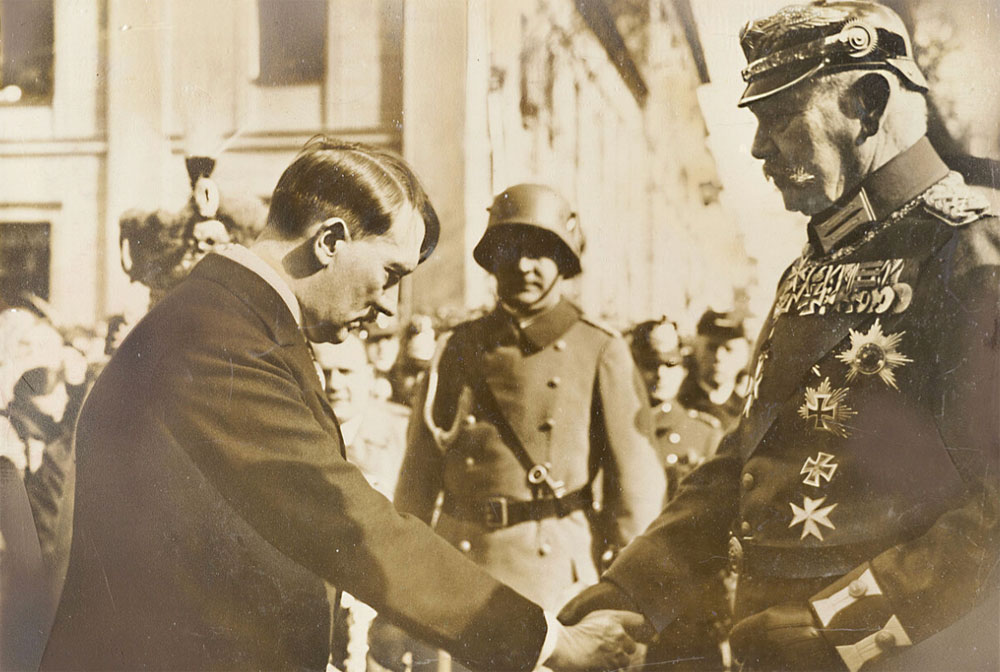
Image: Adolf Hitler and Paul von Hindenburg, Bundesarchiv, Berlin