At Bookhouse, we gather stories about books, unusual bookstores, printers, publishers, and book collectors.
Recently, I came across a remarkable bookseller: Libreria Marini in Rome.
What caught my attention is not only their remarkable collection of out-of-print and rare books, but also a wealth of stories about individual volumes, artists’ books, and magazines. For Italian speakers, they also produce a podcast — Senza fili — dedicated to rare, precious, and little-known books, as well as videos.
Here is a sample of the stories they tell and the rare books they offer for sale.
L’image by Samuel Beckett, with Lithographs by Gastone Novelli
Finally — after years of waiting — L’image by Samuel Beckett, featuring four original lithographs by Gastone Novelli, sees the light of day. Printed by Romolo and Rosalba Bulla in 1961, it is now available again, thanks to Francesco Michielin, in a non-commercial edition limited to 50 copies.
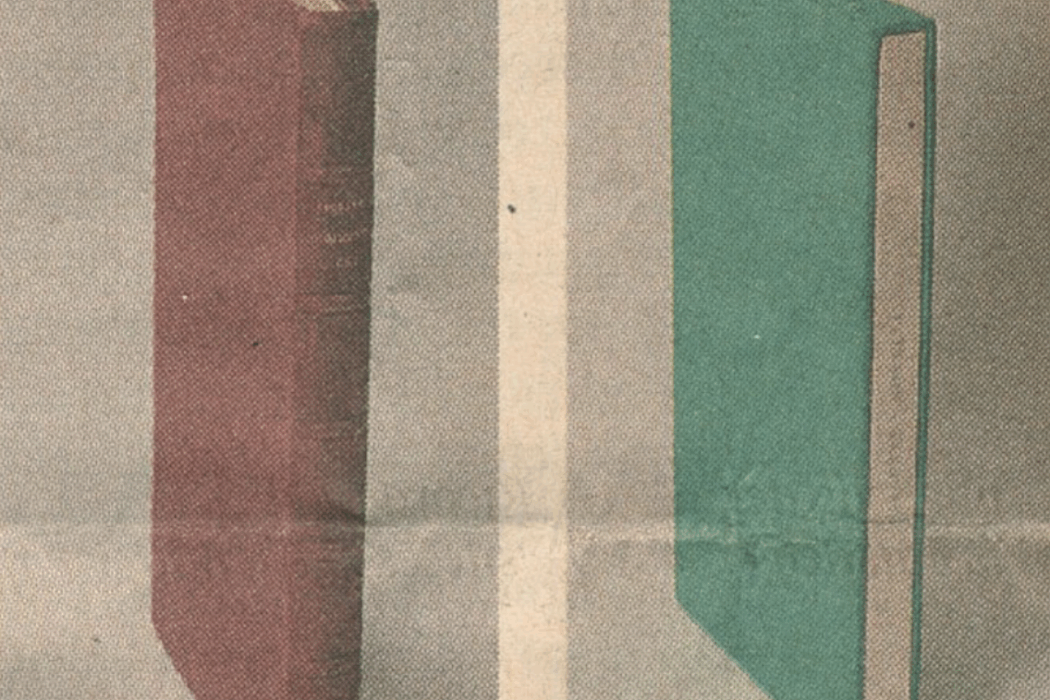
The concept for this plaquette dates back to 1960–1962: Novelli and Beckett were friends and exchanged ideas and impressions regarding art, and even planned to create a collaborative work. Beckett selected L’image—a fragment from his text Comment c’est—which Novelli decided to illustrate with four lithographs, printed by the Bulla brothers in 1961. However, the project suffered a setback and was inexplicably shelved. Then came the artist’s sudden death—though he had managed, just in time, to bind all the project materials into a red leather presentation box. This included the letters exchanged between the two men, as well as Beckett’s letter to the publisher at Éditions de Minuit, who was originally slated to publish the work.
Within that box, there was also evidence of a second attempt to bring the project to life: a note from the publisher Vanni Scheiwiller, who, having learned of the story in 1985, proposed to see it through to completion. Yet, once again, the entire endeavor came to naught.
It was not until sometime between 2000 and 2010—when Novelli’s personal library was acquired by Francesco Michielin, an artist and bibliophile—that the box containing the project materials and the entire print run of lithographs resurfaced. At that point, Michielin resolved to finally bring the plaquette to completion.
The sequence of the images follows the specific arrangement intended by the artist. The text faithfully reproduces the typescript L’image, given to Novelli by Beckett in 1960. The texts were composed and printed by the Tipoteca Italiana Fondazione in Cornuda. The slipcase is bound in green cloth.
At last, Michielin offers this long-awaited volume to bibliophiles and collectors.
Last but not least, I am particularly drawn to Libreria Marini’s advertising approach, as exemplified by this postcard:
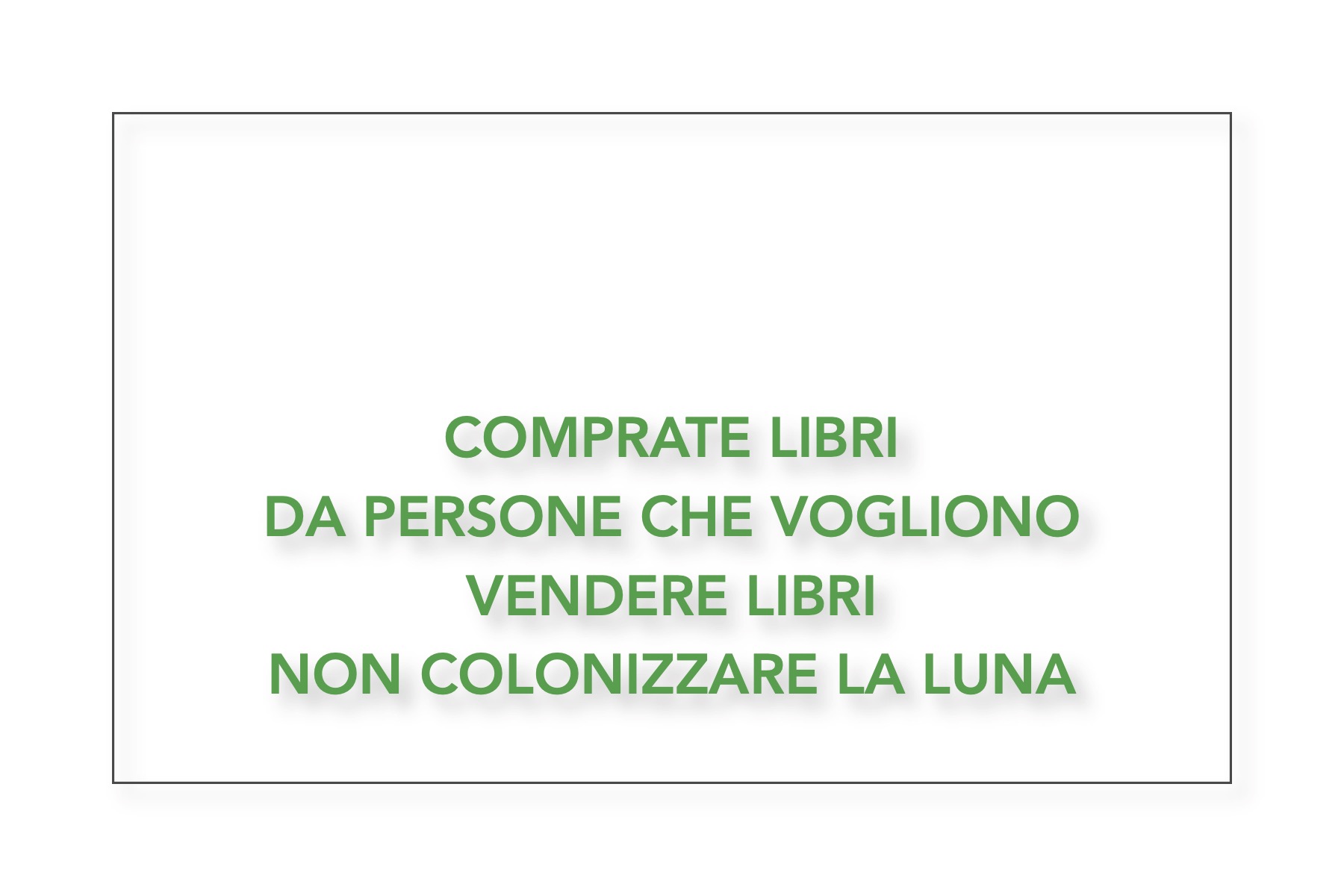
Which translates as: Buy books from people who want to sell books, not colonize the moon.
The serendipitous way I came into contact with Libreria Marini suggests that individuals and institutions who share a passion for the production and sale of books naturally gravitate toward one another.
A further confirmation came in the form of an unexpected email from Lou Giansante, who, following the passing of his friend and neighbor Giancarlo Bragato, chose to donate the late owner’s personal collection of Italian books to Centro Primo Levi. After researching Italian organizations in New York involved in the book trade, he had selected Centro Primo Levi as the fitting recipient. The collection is a remarkable one — featuring hardcover first editions from the 1960s and 70s by Pier Paolo Pasolini, alongside works by Machiavelli and other celebrated Italian authors. The Pasolini volumes are both rare and in pristine condition. They include, among others, Calderon, a play written in 1966 and the only theatrical work published during Pasolini’s lifetime, as well as the film scripts Medea and Teorema in their original, handsome Garzanti editions. By the 1970s, Pasolini — who had begun his career as a poet, novelist, critic, and essayist — had embarked on a second life as a film director. These carefully curated volumes are far more than film scripts. Medea, for example, edited by Giacomo Gambetti in a series called “Film e discussioni,” includes the film’s screenplay, an insert with 48 black-and-white photographic reproductions, previously unpublished poems Pasolini wrote on set, and an interview with Maria Callas, who played the title role. The film exemplifies Pasolini’s lyrical approach: departing from the Euripides tragedy, he reimagines Medea’s myth as a vehicle for his provocative notions of philosophical and sacred reality. Leafing through the photographs, the piercing gaze of Maria Callas draws me in, and I find myself thinking about the complex relationship between the opera diva and Pasolini. Of the many stories woven into this story, I want to linger on one: the use of Callas’s voice. As was customary in Italian cinema of the era, dubbing followed the shoot. Callas dubbed herself — yet Pasolini, dissatisfied, had her re-dubbed by Rita Savagnone. To Callas’s regret, that second version was the one released in theaters. It was later set aside, however, beginning with the 2003 DVD release, for which Callas’s original self-dubbing was restored.
Mr. Giansante, a thoughtful and quietly gracious man, brought his friend’s books to Bookhouse, expecting nothing in return, yet clearly at peace knowing they had found a worthy new home.
We will cherish these volumes and, in honor of their original owner, make them available to visitors at Bookhouse to read and explore. Perhaps someone will be moved to retrace the reading life of Giancarlo Bragato, a travel agent in New York of whom I know nothing, except that he once met Pasolini and cherished his books. And so the stories continue…