Alberto Toscano’s current research is divided into three main strands: a theoretical and historical inquiry into the politics of authoritarianism and their links to the racial, geopolitical and gendered crises of capital, set out in his recent book Late Fascism: Race, Capitalism and the Politics of Crisis; the study of tragedy as a framework through which to understand collective politics and its discontents, from decolonisation to climate action; and the development of ‘real abstraction’ as a heuristic for the analysis contemporary capitalism, notably in its nexus with processes of racialization, automation and digitalization. He also maintains an abiding interest in artistic efforts to represent or ‘map’ racial capitalism, and in the revitalisation of a critical theory of political action informed by anti-colonial and anti-racist thought – as evidenced in his recent collection of essays Terms of Disorder: Keywords for an Interregnum.
Published by permission, Counter Text Vol. 9, No. 2
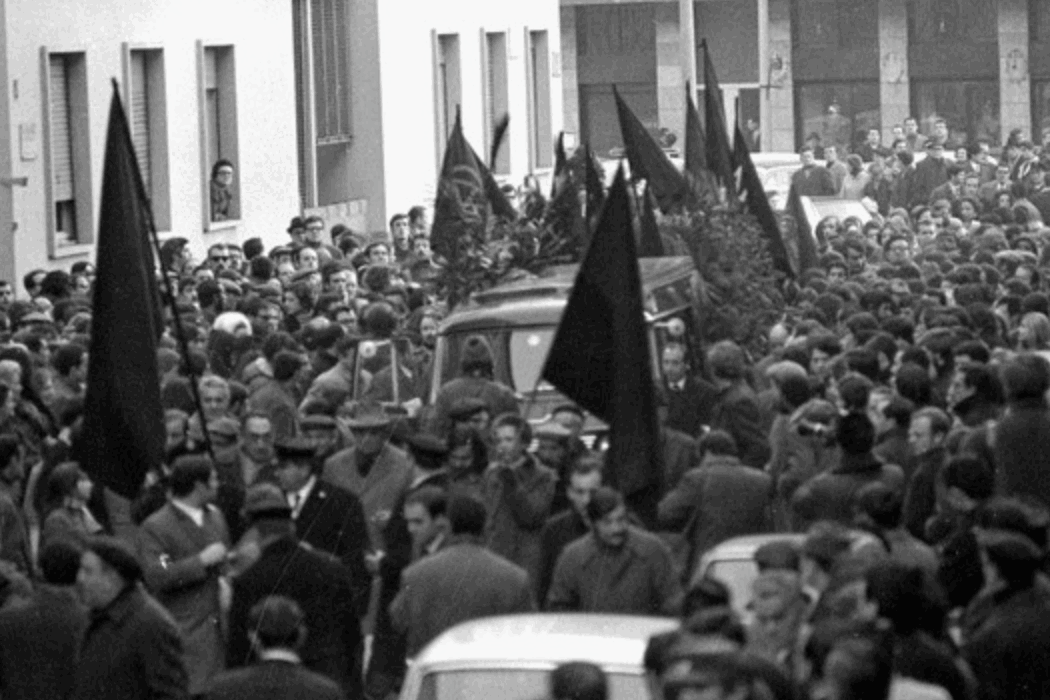
Image: Funeral of Giuseppe Pinelli, the Italian anarchist worker murdered during a police interrogation in Milan, 1969, libcom.org
But does fascism still exist?
It does. It has recovered its countenance from fifty years ago, before the Blackshirts.
The face of conservatism
which on the political market still offers at bargain prices little groups of provocateurs,
so that the small visible fascism
better masks the great invisible fascism.
–Franco Fortini, All’armi siam fascisti (1961)
New Fascisms: Italian Lessons
My working hypothesis and contribution to the recent ‘fascism debates’ is that, contrary to received opinion, the international analyses and polemics of the 1970s on ‘new fascisms’ still have something to teach us, sometimes more so than inventories of similarities between a planetary present of far-right ascendancy and Europe’s interwar hecatombs (see Toscano 2023). This also holds for the vexed question of anti-fascism. I want briefly to reflect on the mutations of anti-fascism at the beginning of what Terence K. Hopkins and Immanuel Wallerstein (1996) have called our ‘age of transition’ (triggered by a global 1968 and still accumulating antagonisms and uncertainties), from the vantage point of the European country where anti-fascism arguably loomed largest in politics and culture, Italy. I especially want to draw on several interventions into public disputes on the afterlives, mutations, and repetitions of fascism by two unique and vital figures of post- war Italian letters – Franco Fortini and Primo Levi.
The brutal onset of the Italian deep state’s ‘strategy of tension’2 with the Piazza Fontana bombing in 1969 (17 dead) – first pinned on anarchists, leading to the ‘accidental death’ of Giuseppe Pinelli,3 and later shown to be a product of the collusion between secret services and neo-fascists – forced an anti-fascist reference back into the political language of the far Left. This led many young militants, notwithstanding the subsidiary or marginal place that anti-fascism enjoyed in their theoretical outlook (whether operaista, libertarian-communist or Marxist-Leninist) to foreground anti-fascist action. It also led a substantial cohort of activists, as well as prominent figures like the publisher Giangiacomo Feltrinelli, to envisage the necessity of a rebirth of armed resistance on Italian soil.
The degree of violence by agents of the state and neo-fascist elements in the period between 1969 and 1974 is worth recalling. 1974 saw the bombing of the Italicus train (4 August; 12 dead) and of a mass anti- fascist demonstration in Piazza della Loggia in Brescia (28 May; 8 dead, 102 wounded). It is in 1974 (17 June, in Padua) that the Red Brigades carry out their first murders (of two militants of the neo-fascist MSI, though these, unlike other later actions, were not planned). At the end of this same bloody year of 1974 the weekly L’Europeo hosted, on contiguous pages, interviews with two poets and communist intellectuals, Pier Paolo Pasolini and Franco Fortini, on the ‘new fascism’.
The surface echoes, and deep differences between their perspectives are worth noting. Pasolini, taking up an apocalyptic polemical stance that marked his public pronouncements and prophecies in the years before his own murder, denounced what he called the ‘archaeological anti-fascism’ that took as its ‘object and objective’ an ‘archaic fascism’–that of the charismatic Duce and his oceanic crowds – which he deemed fully defunct, undermined by massive technological and societal transformations. That fascism would not repeat itself and the ‘classic’ anti-fascist position was a comfortable and conformist one, either naïve or in bad faith. But, above all, it represented for Pasolini a way of neglecting the true, new fascism – that of the ‘anthropological genocide’ meted out by a consumer society bent on transforming Italians to their very root, obliterating cultures, habits, bodies, and mentalities. What the ‘new’ fascism targeted was a sedimented social habitus which, Pasolini further suggested, the ‘old’ fascism had barely impacted over its two decades of rule. It is only fair to note that this provocation, ill-received by the vast majority of the intellectual Left, had its stark contemporary references – when Pasolini scandalously declared that the fascism of the past (that of the ventennio) was ultimately ‘better’ than the one of the present, he did so by juxtaposing the comparatively few political murders carried out by Mussolinian fascism on Italian soil in peacetime with the state-incited or abetted massacres that defined the strategy of tension, which fostered a climate of instability verging on civil war to undermine any Communist challenge to Christian Democrat hegemony and neo-capitalist power. For Pasolini, to present neo-fascists as the principal culprits of the bombings was instrumental to covering the tracks of the forces that truly ruled the country.
Fortini, who elsewhere polemicised bracingly with his erstwhile friend Pasolini,4 in L’Europeo also minimised, as he had done in his 1961 text for the film-essay All’armi siam fascisti, the significance of outright neo-fascism. But the terms in which he did this were very distinct from Pasolini’s. To begin with, he tried to qualify the novelty of this polemic by recalling what he took to be its source – an article from 1946 by the novelist and essayist Elio Vittorini in the Left cultural journal Il Politecnico, entitled ‘Are the Young Fascists?’. In that piece–whose effort to cleanse young people who had rallied to fascism of any true responsibility was alien to Fortini – Vittorini had distinguished between fascism as adjective and noun, as violent appearance and as structuring essence. As in Brecht (‘Those who are against Fascism without being against capitalism, who lament over the barbarism that comes out of barbarism, are like people who wish to eat their veal without slaughtering the calf’) or Horkheimer (‘Whoever is unwilling to talk about capitalism should also keep quiet about fascism’), this was a polemic against a liberal, pro-capitalist, and therefore inconsequential anti- fascism.
Vittorini argued against what he judged as reactionary propaganda deriving from English and American sources, as well as from the Vatican, which wanted to treat fascism as a historically circumscribed moral aberration, solely emphasising its ‘executive aspect’–the violence of its methods, the materiality of its dictatorship, the barbarism of its rhetoric – while occluding any insight into its causes. It is the latter that are at stake in fascism as a noun, namely the ‘political-economic aberration’ that is capitalism in its defensive posture against any development of proletarian democracy: a capitalism no longer wishing to pay the price of political freedom. Fascism constitutes ‘an extension of capitalist dictatorship into the field of politics’, though it may look liberal on the surface. As Vittorini argued:
Now that it has reached the extreme stage of its development, capitalism no longer needs political freedom. It tolerates it as a kind of price that it pays in exchange for the right to exercise its economic dictatorship. But this price becomes more and more expensive, it becomes dangerous, it threatens to eliminate its class dictatorship, and here is capitalism trying not to pay it anymore. Any attempt made by capitalism to stop paying it, or to reduce it, to limit it, to shift it into a credit account, to turn it into wastepaper, etc., is fascism. (1946: 2)
Fortini recalled a widespread post-war critique that castigated the conventional, conformist anti-fascism which – with the emergence of the Italian Centre-Left governments of the early to mid-1960s – acquired a kind of official status. As he wrote:
[I]n the sixties we saw the growth of this oratorical, verbal, unifying, inter-classist, ultimately hypocritical and complicit anti-fascism, which even became the government’s banner. When in ’65 President Saragat came to celebrate the twentieth anniversary of the Resistance there were violent protests by the young (protests that presaged what ’68 would come to represent) against the intolerable hypocrisy that wanted to fuse the anti- fascism of the resistance with official anti-fascism, with the official doctrine of the democratic state: where by “democratic state” we mean not so much the state of the Constitution but that apparatus of government, sub-government, mafia and sub-mafia which all Italians know. (1974: 47)
And yet, Fortini continued, philological disputes aside, a fascism did exist in the present, the kind which, in his allegorical turn of phrase, can conjoin 300,000 cars idling under the rain at FIAT Mirafiori with thirty million dying of famine in India – it was this capitalist nexus of violence that led Fortini to criticise his own scepticism (elsewhere voiced by Adorno with reference to The Resistible Rise of Arturo Ui; see Adorno 1992) about the apparent crassness of Brecht’s anti-capitalist polemics in The Three-Penny Opera and other works. But Brecht’s capitalist ‘proverbs’, notably Macheath’s famous turn about the founding and robbing of banks – echoing Jean Jaurès’s quip that the bourgeoisie carries war with it like clouds carry storms – ring all too true in a moment when:
it is impossible to distinguish between the so-called democratic state and fascist conspiracies, when between the one and the other there is the same circulation as between veins and arteries, since they ultimately belong to the same system. Today, what was previously true only for the Left has become true in the eyes of everyone, namely that bourgeois democracy does not exist, that it is an empty façade. And that is why promoting anti-fascism in the name of this democracy is ridiculous, specious, and hypocritical, regardless of which label one does it under. (Fortini 1974: 47)
Fortini also responded to the case of anti-fascist ‘intolerance’ (violent de-platforming) that had elicited the magazine L’Europeo’s inquiry among intellectuals. He castigated it for its political inefficacy, while also criticising any anti-fascism that would descend into moralism, to waging civil war on the cheap: ‘It is important to carry out certain actions when they have a price and are useful, not when they don’t and are not.’ A ‘serious anti-fascism’, he asserted, is grounded not in ‘intellectual or moral judgments but in historical and political ones. [Fascists] are not sinners; they’re enemies’. And these are enemies who have ‘a thought, a philosophy, a culture’. At the core of Fortini’s intervention into the 1970s debate on the new fascism and anti- fascist action we behold not the oracular provocation wielded by Pasolini but rather an emphasis on the necessity of a political, cultural, and linguistic judgment, to which Fortini will often give the name of verifica, a verification or test. As he told his interviewer, what the 1968 extra-parliamentary Left ‘wanted to be above all is a test of names [una verifica dei nomi], a test for authentic anti-fascists beyond the taking of comfortable stances.’
Fortini had addressed this skein of problems from a more intimate if equally political angle in The Dogs of the Sinai, a polemical essay elicited by the Italian and Jewish response to the Israeli-Arab War of 1967. Dogs, which served as the basis for Jean-Marie Straub and Danielle Huillet’s remarkable film Fortini/Cani, doubles as Fortini’s most sustained and coruscating memoir of his and his father’s experience of anti-Semitism in the Fascist-ruled Florence of the 1920s and 1930s; it is also a poetically dense and politically over-determined effort to begin thinking about the relations, which the 1967 conflict brought painfully to the fore, between anti-fascism, anti-Semitism, and anti-imperialism. Fortini’s attack on the comforting illusions of frontist unity is unsparing, taking on not just a pro-Zionist consensus among many of his acquaintances and much of the mainstream press, but also the debility of the PCI’s Soviet tailism and unreflexive Nasserism.
With a customary self-violence which is anything but self-hatred, but rather its intimate and dialectical antidote, Fortini wrote: ‘From the end of the war, I interpreted my Jewish father and my mark of circumcision in a manner that I now grasp as worse than partial, lazy like the Fascism/anti- Fascism schema which that aura inhabited. . . . In practice – in the practice of laziness – I had accepted the absurd idea that Jewishness, anti-Fascism, resistance, and socialism were contiguous realities. How easy it is to fool oneself’ (2013: 20). What prompted this auto-analysis and self-criticism was the phenomenon unleashed by the ’67 war ‘in the new or recent Italian petty bourgeois’, ‘the desire to be on the good side . . . to unburden themselves of fascist guilt – the only guilt which, in part and only in the guise of German Nazism, that stratum is willing to recognize; to unload on the Arab the hatred accumulated against the generation of the fathers, against misery, the peasant mother, redundancy, rags, military braggadocio, illiteracy’ (Fortini 2013: 7).
In these very personal and solitary pages, Fortini was ultimately seeking to go beyond exhorting anti-fascists to think about the capitalist norm that shapes the moral aberration and barbaric appearance of historical fascism; he was seeking to deprovincialize anti-fascism by breaking open the Italian and European horizon of the debate, to rethink it in light of the insurrections of the Third World. As he wrote in Dogs: ‘Many European Jews and many European Italian friends of the Jews have let themselves be overtaken in the sleep of their old anti-Fascism. They will have to rethink their youth and judge it. The limit and the scandal have arisen from an encounter with immense masses that neither want to nor can “assimilate” or enlist among the tirailleurs sénégalais, the Gurkhas, the rangers of the oil tycoons or the CIA’ (Fortini 2013: 38).5 Notwithstanding deep differences in their political and literary sensibilities, as well as their relationship to Judaism and Jewishness, this imperative to think fascism and its returns in a fully international horizon would also rear its head in the writings of the foremost Italian chronicler of the destruction of the European Jews, Primo Levi.
‘Every era has its fascism’
When the first edition of If This Is a Man was published by a small independent press in Levi’s hometown of Turin in 1947, having been passed over by the bigger publishing houses, the book sold fewer than 2000 copies, and Levi turned back to his original career as a chemist. Only in 1958 would Levi’s (thoroughly revised) chronicle of Auschwitz encounter a wider public, going on to become one of the most important and internationally recognised artistic documents of the Holocaust.
Among the reasons for the book’s delayed reception was the way in which it troubled a post-war image of the defeat of Nazism (and of Italy’s civil war against Fascism) that centred on heroic narratives of the Resistance. Levi was captured as a partisan (in a band linked to the liberal-socialist Partito d’Azione) but deported as a Jew. He recalled his own experience in the Resistance as a blend of human tragedy and political immaturity (see Luzzatto 2016).
Levi’s work and testimony emphasised the profound and painful differences between the Jewish deportee and the heroic figure of the resister. He explored not just the systematic horror of the camps, but also their afterlives in experiences of shame, isolation, and guilt. One of the foremost contributions of Levi’s work was to interrupt and problematise a heroic narrative of the Resistance, which all too easily repeated the rhetorical evasions of nationalism and patriotism. In a 1960 article for a monthly educational magazine called The Parents’ Magazine, Levi mused that the lessons of the Resistance itself were threatened not just by its nostalgic enemies on the far right, but also by ‘prematurely embalming the Resistance, relegating it obsequiously to the noble castle of the History of the Homeland’. What he advocated instead was a sober, self-critical realism – in the same spirit of painstaking observation and truthfulness that he often linked to his own scientific training. As he declared:
[I]f we wish our children to feel these concerns, and therefore feel that they are our children, we should speak to them a little less of glory and victory, of heroism and sacred ground, and a little more of that hard, dangerous, and thankless life, the daily strain, the days of hope and of despair, of our comrades who died doing their duty in silence, of the participation of the populace (but not all of it), of the errors made and those avoided, of the conspiratorial and military experience painfully acquired, through mistakes that were paid in human lives, of the hard-won (and not spontaneous, not always perfect) agreement among the supporters of different parties. (Levi 2015: 1137–8)6
Levi also revisited, with great moral tact and political sympathy, the tragic history of resistance in the camps themselves (he would also go on to deal with Jewish resistance against Nazism in his last novel, If Not Now, When?). In an article from 1965 on ‘Resistance in the Lagers’ (included in a volume published by Turin’s phone company, with the unlikely title The Telephone in the Resistance), Levi provides a precious glimpse into the overwhelming odds faced by the camp’s inmates and the courageous ingenuity with which clandestine networks were organised ‘to limit, or at least control, the decimation of those who were most useful politically; to save Allied parachutists, and eliminate many spies and collaborators; to carry out cautious actions of sabotage in the workshops and at the worksites, especially in the weapons factories; to listen to and spread news of the war at the front by means of secretly built radios; to maintain relations with other camps’ (Levi 2015: 1162–3).
But Levi also underscored how the negligible military power of resisters in the camps was complemented by their moral force: ‘The perception, the rumor that inside the barbed wire a friendly presence survived – a power mysterious and undefined but different from and opposed to National Socialism – was extraordinarily valuable to all the prisoners, and helped sustain their will to live’ (1163). We also cannot ignore how the resources of the ‘political’ prisoners and those of the Jewish inmates differed. As Levi wrote about the majority of the prisoners of the extermination camps in his 1976 appendix for the schools edition of If This Is a Man?: ‘their sojourn in the Lager was tragically short; they were, in other words, a fluctuating population, continually thinned by death, and renewed by the ceaseless arrival of new convoys. It’s understandable that in a human fabric so deteriorated and so unstable the seed of revolt did not easily take root’ (176).
Levi’s greatest analytical contribution to our understanding of the camp as a hideous ‘laboratory’ experiment with human nature and sociability is arguably that of the ‘grey zone’. This is the term with which, in The Drowned and the Saved (1986), he accounted for the role of ‘the hybrid category of inmate-functionaries’, a category that ‘both separates and connects the two opposing camps of masters and servants’ (2434–5). For Levi, this grey zone was marked by ‘an incredibly complicated internal structure’ which poses daunting barriers to our powers of moral and political judgment. It is striking in this regard that Levi’s essay on resistance in the Nazi camps culminated in his account of the October 1944 revolt of the Auschwitz- Birkenau Sonderkommando, the ‘special squad’ of prisoners in charge of the gas chambers and cremation ovens – whose dreadful ‘privileges’ within the camps were accompanied by knowledge of their inescapable demise. Levi captures the revolt with searing insight:
In this desperate fight at the doors of the cremation ovens only a dozen SS men were killed. Nevertheless, the insurrection, which immediately became known in all the camps of the Auschwitz district, was an event of enormous importance. It revealed a gap, a crack in the steely edifice of the concentration camp; it proved that the Germans were not invincible. For the Germans themselves it must have sounded an alarm, because a few days later the camp command at Auschwitz started to dismantle and blow up the workshops of death that alone had swallowed more human lives than all the other concentration camps combined. Maybe they acted in the absurd hope of destroying all evidence of the greatest crime ever committed in the entire, and yet so bloody, history of mankind. (1165)
A much less ambiguous revolt also makes its appearance in many of Levi’s essays, namely the Warsaw Ghetto uprising. In 1979, Levi wrote an article in response to the broadcast of the American TV serial Holocaust.7 His critical observations on the representation of the uprising bear witness to his unflagging efforts to defend historical accuracy, but also his increasing emphasis on anti-fascist memory:
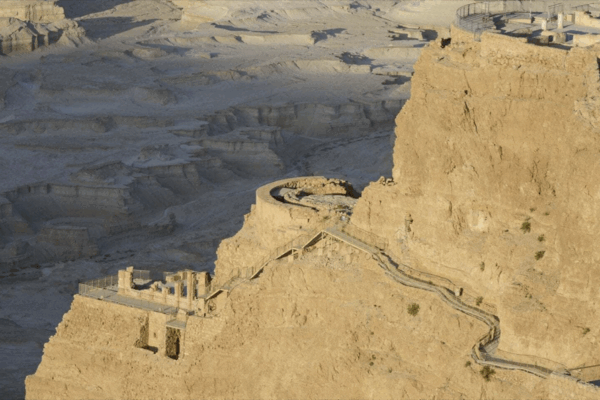
This momentous and desperate fight, which will never be forgotten and which in the show [Holocaust] achieves an extremely high level of tension, was not just a heroic attempt to reaffirm the dignity of a victimized people. It was also the continued development of an old and many-sided effort, reviving the stoic virtue of the defenders of Masada against Titus’ powerful army, the millenarian and messianic zeal of early Zionism, and the interpretation of the Marxist vision by the Jewish proletariat of Warsaw, doubly oppressed, as proletarian and as Jewish. (1289)
Whereas today the memory of the Holocaust (a term the Levi was uneasy with) is so often separated from the politics of anti-fascism, for Levi memory and anti-fascism remained – in spite of the critical distinctions between the deportee and the resister – inseparable. Not only were many of his articles and talks produced for events and publications organised by organisations of veterans of the resistance, but he increasingly endeavoured to make links between his own experience of brutal domination and inhumanity at Auschwitz and fascist tendencies in the present.
In 1980, Levi wrote a text for the National Association of Ex-Deportees on a monument at Auschwitz on which he himself had collaborated with the avant-garde composer Luigi Nono, the architect Ludovico Belgiojoso, the painter Pupino Samonà, and the film director Nelo Risi. He took pains to stress the political, which is to say the anti-worker and counter- revolutionary history of fascism, and to connect its Italian genesis with its German apotheosis. As he declared:
The history of deportation and of the death camps, the history of this place, cannot be separated from the history of the Fascist tyrannies in Europe. There is an uninterrupted link from the burning down of labor union offices in Italy in 1921 to the bonfires of books in German squares in 1933 and the heinous blaze of the Birkenau crematoriums. This is old wisdom, and Heine, a Jew and a German, had already admonished us: those who burn books end up burning people; violence is a seed that doesn’t die.
It’s sad but necessary to remind others and ourselves: the first European attempt to smother the workers’ movement and to sabotage democracy was conceived in Italy. (1340)
Levi glimpsed, at the core of fascism, the rebirth, under modern industrial conditions, of a society founded on slavery, on ‘the paranoid logic of profit above all else, of exploitation without restraint, of man reduced to instrument’ (as he would write in ‘Women for Slaughter’, 1978). He told middle-schoolers, in a special educational edition of If This Is a Man, that the ‘full realization of fascism’ would have divided the world into an aristocratic ‘master race’ (Herrenvolk) and ‘an immense flock of slaves, from the Atlantic to the Urals, [forced] to work and obey’. Levi pithily defined fascism as ‘the consecration of privilege, the definitive establishment of non- equality and non-freedom’ (1193). He also warned students that any relief at the vanquishing of fascism was premature – while Auschwitz had not been repeated, too many signs pointed to the vitality of Fascist methods and inclinations.
Levi was fond of quoting Bertolt Brecht’s lines from the play The Resistible Rise of Arturo Ui, ‘The womb that gave birth to this monster is still fertile’. He would have likely agreed with Toni Morrison’s admonishment that ‘before there is a final solution, there must be a first solution, a second one, even a third’ (Morrison 1995: 384). In his acerbic 1977 article on Nazisploitation cinema, he observed that ‘there are concentration camps in Greece, in the Soviet Union, in Vietnam, in Brazil. In almost every country there exist jails, reformatories, psychiatric hospitals, in which, as in Auschwitz, man loses his name and his face, dignity and hope’ (Levi 2015: 1193). Above all, Levi held fast not just to the painful imperative of bearing witness but to the political principles of an anti-fascism that could be something more than a faded historical relic or a political fetish. For, as he observed:
Every era has its fascism; the warning signs can be seen wherever the concentration of power denies a citizen the opportunity and the capacity to express and carry out his will. There are many ways of arriving at this point—not necessarily through the terror of police intimidation but also by censoring and distorting information, polluting justice, paralyzing schools, disseminating in many subtle ways nostalgia for a world where order reigned supreme, and where the security of the privileged few rested on the forced labor and forced silence of the many. (1198–9)
Amid the debates over the virtues and dangers of fascism talk that have emerged in response to the worldwide wave of authoritarian politics, it is helpful to recall that many of those who experienced on their own person the full brutality of interwar fascism were deeply sensitised, as Levi was, to fascism’s differences and repetitions. The widespread conviction among anti-fascists – in the immediate aftermath of the war, in the face of (settler-)colonial violence or quotidian capitalist cruelties, and again through the counter-revolutions of the 1960s and 1970s–that fascism did not perish in Hitler’s bunker, that it could resurface in mutable and even unrecognisable forms, was also accompanied, as I’ve tried to explore, by critical, clinical, and conjunctural reflections on the politics of naming fascism. In our own moment, when ‘invisible’ molar and molecular processes of ‘fascisation’8 are accompanied by the brutal deeds and boisterous rhetoric of ‘visible’ fascists, it remains instructive to revisit how poets, novelists, and essayists of the calibre of Levi and Fortini (and Pasolini) wrestled with anti-fascism as a problem not just of action but also of language.
Notes:

1. Unless otherwise noted, all translations are my own.

2. Though drawing on Italian debates, the formula ‘strategy of tension’ was initially coined by the journalist Neal Ascherson and his colleagues in an article in The Observer on the Piazza Fontana bombing. See Ascherson et al. 1969.

3. Pinelli was a railroad worker and secretary of the Italian branch of the Anarchist Black Cross. He ‘fell’ out of the window of the Milan police station where he was being questioned on 15 December 1969. The event is dramatised in Fo 1988. In 1970, Elio Petri filmed a short documentary with the actor Gian Maria Volonté unpicking the diversions and inconsistencies that pervaded the state’s accounts of the incident, Tre ipotesi sulla morte di Pinelli (Three Hypotheses on the Death of Pinell). Available online at: https://www.youtube.com/watch?v=m90i-eVWVbQ.

4. SeeToscano2016,myintroductiontoFortini2016.Fortini’sATestofPowersalsofeatures his crucial intervention into the cultural debate on anti-fascism, the essay ‘The Writer’s Mandate and the End of Anti-Fascism.’ Fortini’s writings on Pasolini are collected in Fortini 1997.

5. Two years before the end of his life, on the thirtieth anniversary of the Italian edition of The Wretched of the Earth, and in response to the Gulf War, Fortini – not avoiding a pessimistic note on the fortunes of liberatory violence – would nevertheless enjoin his readers to ‘Bring Back Fanon’, commenting on the knee-jerk response to any recollection of the Martinican thinker’s revolutionary rhetoric: “The idiot who, one eye open, dozes in all of us, opens the other one. And smiles. What use do we have, he mutters, for this kind of oratory, after so many catastrophes and refutations? Open your newspapers or walk in the streets. You’ll soon find out” (Fortini 2015).

6. All quotations from Levi are taken from Levi 2015, especially Uncollected Stories and Essays, 1949–1980, translated by Alessandra and Francesco Bastagli, included in Volume 2. I draw here on the indispensable Belpoliti 2022, as well as on Traverso 2021.

7. The series was also the object of a reflection by the philosopher Günther Anders (see Anders 2014). German original in Besuch im Hades: Auschwitz und Breslau 1966; Nach ‘Holocaust’ 1978, Munich: C.H. Beck, 1997.

8. See my review of Ugo Palheta, La possibilité du fascisme: France, la trajectoire du désastre, Toscano 2021.
Copyright of CounterText is the property of Edinburgh University Press. We are grateful to the editors, James Corby and Ivan Callus for giving Centro Primo Levi the permisison to reproduce the article.