Alessandro Cassin interviews Ethan Wolff about his work with the Thought Gallery.
New, good ideas thrive when they reveal and meet previously unrecognized needs. This is the case of a website created in 2004 by David Miller, CEO of Davler Media Group, who came up with a brilliant name — Thought Gallery — (thoughtgallery.org) and the ambitious objective of creating a site dedicated to NYC’s intellectual life. Rather than searching social media, the cultural calendars of dailies and magazines, or subscribing to the myriad cultural associations, museums, and institutes that offer public programming, Thought Gallery serves as a one-stop curated list of intelligent events, accessible for free via a weekly newsletter (The Curriculum).
Sifting through the city’s overwhelming cultural offerings, Thought Gallery selects a wide variety of events from lectures to panels, talks, tours, and anything else that pertains to intellectual discussion. The strength and added value of its listings lies in its rigorous, intelligent, man-made curatorial approach: not quantity, but quality; not empty marketing, but articulate choices.
Centro Primo Levi’s relationship with Thought Gallery is two-fold; we are delighted users, and we have often been honored by the inclusion of our events in their listings. To take a closer look at Thought Gallery, we sat down with Ethan Wolff, its Director and content manager—”the curator.”
Alessandro Cassin: First of all, congratulations to you and your staff for the outstanding job you do. Can you tell me a bit about when you started this, your background, and what you feel you have learned through Thought Gallery?
Ethan Wolff: I joined back in 2014, two years after its creation. I didn’t come in cold. I had written New York guidebooks for years. One of my specialties was affordable and free things to do in the city. So I knew much of the museum programming and places with quality cultural events. On the job, I found even more of them as I observed the city change in many ways.
AC: The world is changing rapidly, and it seems to me that today, for both a younger and not-so-young audience, a cultural calendar by email is more in step with the times than a newspaper listing or social media (which seems to change too rapidly).
EW: I agree, this medium is kind of natural for people who want to be informed, and check time and place pretty close to the actual date.
Compared to print, we are able to make last-minute changes. Sometimes events get cancelled, sell out, or change venues. We have to be able to provide that information more or less in real time.
AC: As traditional newspapers and magazines struggle with advertising and diminishing readership, a simple newsletter is much more sustainable, even from a financial point of view, I imagine. I appreciate the essential, legible, and bare-bones look of your site, in a time of exaggerated and often uncalled-for “production value”.
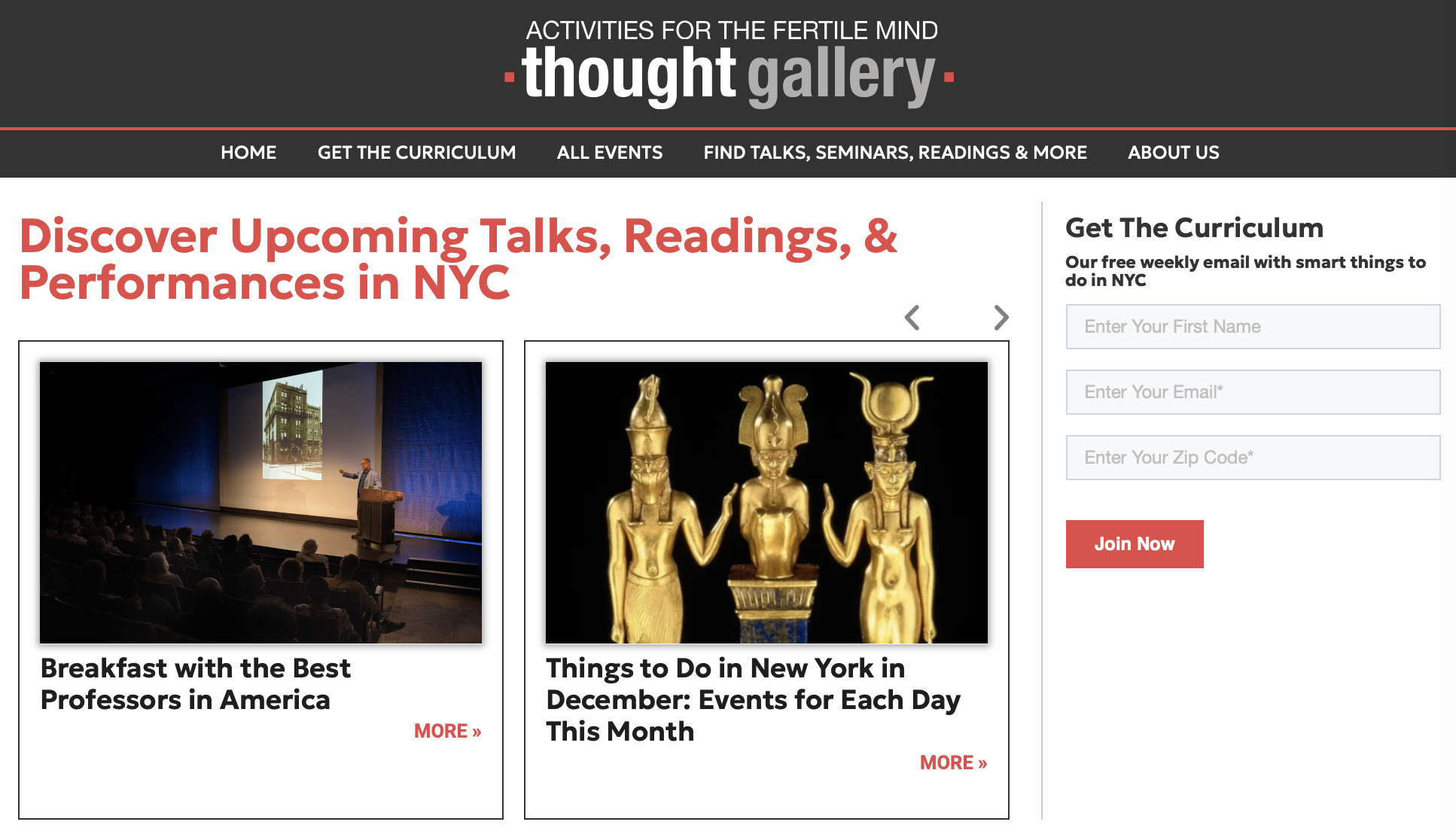 EW: We want to keep the site simple and functional. Our audiences find the events we recommend without too many images or distractions.
I think there’s something to be said for not overwhelming people. And again, not using gimmicks when we don’t need them. As far as traditional media, even The New York Times or The New Yorker has reduced its cultural coverage. So many elements of publishing stopped being profitable. People are turning to AI to keep informed, but it is not the same thing… What AI cannot do is “curate” and discern quality over quantity.
AC: What have you learned about New York’s intellectual life since working at Thought Gallery?
EW: New Yorkers are intellectually extremely curious, well-informed, and eager to learn more. It’s a city that offers something for everybody, from broad general-interest events to the most niche. Initially, I was focused on institutions and venues that offered sophisticated programming and things to do for free. And there are many! But recently, I have to say, audiences do not mind paying for a ticket to a talk if the content is engaging enough. With not a ton of money, one gets a lot out of the city. And now, the money thing isn’t as important. Audiences like to support the arts. They like to support this kind of culture. To get back to your question, I did not realize the breadth and extent of what New York City offers.
AC: How many events do you typically list?
EW: We have five or six hundred events listed on the calendar at any given time, a testament to the vitality of this city. And the number of our audience is growing as well: this November, it was higher than it has been for months.
AC: How big an audience did you reach when you started, and how big is it now?
EW: When I started, there were maybe 2,000 people on the email list, and since then, the list has kept growing through people coming to the website and word of mouth. We are now at over eleven thousand and growing. Naturally, we had a significant drop during the pandemic, but we are now exceeding pre-pandemic numbers. and the website grew from having very strong Google leverage.
If you google “talks and lectures in New York City,” we’ve been number one for 12 years. If there is a very specific thing that you’re looking for, Thought Gallery generally has it listed. Then the question is: how many people among our 7 million fellow New Yorkers are looking for talks, lectures, and smart things to do, and how many are doing so any given week in New York… Our audience is mostly educated people who live in Manhattan and Brooklyn. They are either on the younger side without kids or on the older side. The kids have left the house, so they have time to go out and do these things.
AC: Yours is a quality product, and that is always rewarded in New York.
EW: We are able to connect that audience with what they’re looking for and sometimes suggest something they didn’t know existed… that’s been the approach.
AC: With all your experience, are you now able to predict which ones of your listings will attract larger audiences?
EW: Yes and no. It’s tricky: poetry and fiction are always prominent on the list. Surprisingly, many of the art talks don’t do as well as you might think. I’m very interested in climate change and take every opportunity to read about it, but events on the subject are hit-or-miss. On the other hand, our audience does not seem to miss any opportunity to get into an institution or architectural site after-hours, or be guided to hidden and unknown places. Anything that discusses consciousness or neuroscience is always going to pop right off the charts in terms of reader interest, so I do favor those kinds of things. Religion is often a big source of interest, as are hybrid events of different sources.
AC: Are you sometimes wrong in your predictions?
EW: Of course! Sometimes I see something that sounds to me way too niche. Why would anyone be interested in this overly specific topic? And of course, that ends up being the most popular click of the week because it’s specific, and I think there’s an element in human intelligence that responds to the very specific.
AC: What keeps you personally going with this project?
EW: I still love my job. I like to focus on the uniqueness of Thought Gallery and the uniqueness of New York. I am thrilled by the experience of going down the week ahead, or even one day in New York, and maybe we have 20 events on the site, that sounds great.
AC: Among Thought Gallery’s categories, there is “History”. On one side, this is not a category one finds in Time Out NY or The New Yorker. On the other hand, it’s one of the most heated topics in the current public debate. How do you approach the attempt to engage audiences with history?
EW: History has always been one of Thought Gallery’s most popular categories. As the readership evolves, I’m seeing more interest in New York City history in particular. Recent presentations on the Gilded Age have been doing very well, for example, I think in part as a reflection on the current era’s echoes with that time. History as a moral inquiry and history as a contextualizer for the present are both popular approaches. History is another category where some talks would appear too narrow to have wide appeal, but actually seem to attract by virtue of their specificity. In terms of history being a heated topic, of course, what we see at Thought Gallery reflects programming for a New York audience, so we don’t really encounter the more specious programming.
AC: Do you actively research events based on ideas that you feel are important?
EW: I tend to have all the available events at my fingertips, so I don’t research for upcoming events. I am more likely to flag themes and trends. Some newsletters will have a thread that connects multiple events, and the monthly calendars will hit recurring points as well. This year has certainly lent itself to talks around national identity, authoritarianism, systems, political economy, and what defines intelligence in light of the AI revolution.
AC: How do you select the quotes that appear in the Curriculum?
EW: My favorite source for the newsletter quote is an actual speaker from next week’s talk, or a subject of one of the presentations. Barring that, I look for quotes that are related to a theme—although it gets trickier to find them as I’ve stopped repeating speakers and have had to branch out. Often, I’ll encounter an unfamiliar name in the course of a week’s reading, and that will send me down a rabbit hole of an entire unknown mode of thought, and in the best cases, uncover a quote pithy enough to include.
Image: Berenice Abbott, New York, 1930s