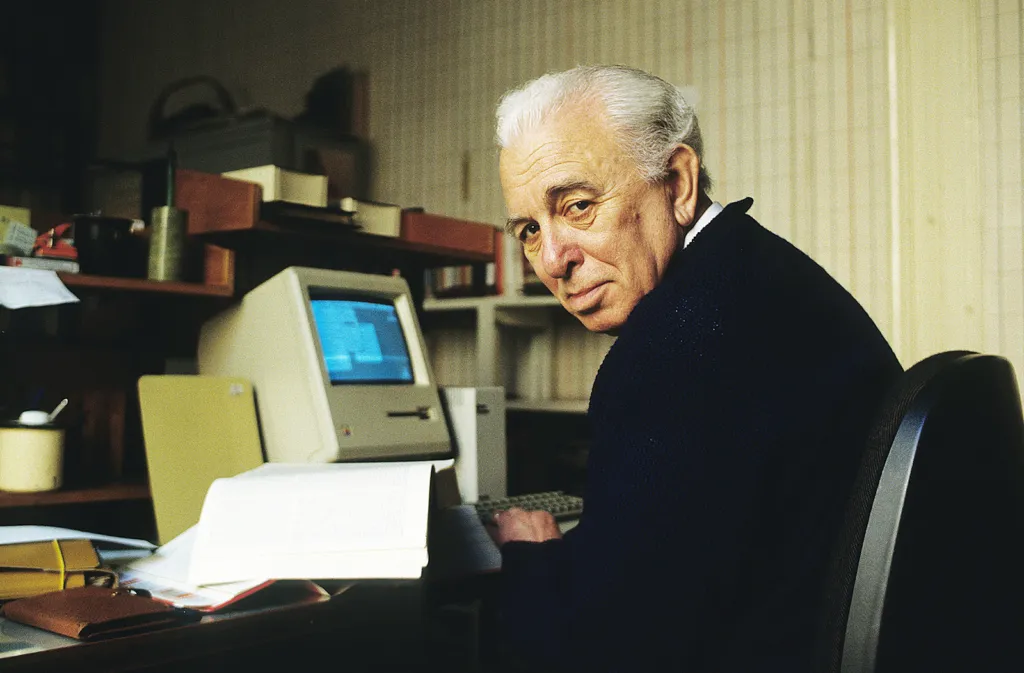
Barry Schwabsky is an art critic, art historian and poet based in New York City. He is currently an art critic for The Nation and co-editor of international reviews for Artforum. His essays have also appeared in publications such as Flash Art, Contemporary, Artforum, London Review of Books, and Art in America. He has written the art criticism books Words for Art: Criticism, History, Theory, Practice and The Widening Circle: Consequences of Modernism in Contemporary Art, as well as books on Jessica Stockholder, Mel Bochner, Chloe Piene, Karin Davie, Dana Schutz, Alex Katz, Gillian Wearing: Mass Observation, Henri Matisse and Alighiero Boetti, among others.
With an Attempted Translation of a Poem by Franco Fortini (original post).
Last October, Norman Finkelstein and Henry Weinfield posted on Norman’s poetry review website Restless Messengers an invitation to its readers to take part in a dialogue on political poetry. I immediately wrote an off-the-cuff response, aiming not to stake out a definite position but to contribute to the dialogue by explaining in a straightforward way the development of my thoughts on the topic over the past decade. It was meant to be material for further discussion—a sketch to be developed later, in dialogue.
In the end, it seems that—surprisingly enough—they did not get enough substantive response to pursue the projected discussion forum for publication. Although the response I drafted might be too skimpy to serve as a standalone text, I nonetheless offer it here in case it can, as intended, spark some kind of conversation somewhere. The text has been lightly revised from the version I drafted in October, and certain passages have been filled out, but it remains no more than a sketch. As an aside, I should mention that the quotation from Michael Palmer’s “Sun” responds to a citation in Norman’s text, which you can read here.
After Trump won the 2016 election, I began to feel, as many others did, that I should get more actively political. Thinking the best course would be to pick one issue or area of concern to focus on, I joined Jewish Voice for Peace. But the truth is that, although I continue to support that organization to this day, I never became very active. I’ve never been a great one for marching. I do pessimism of the intellect better than I do optimism of the will.
At the same time, I thought that perhaps also my poetry ought to become more political. But how? The more I thought about it, the less I understood what political poetry is or could be. I decided that the best way to get a deeper understanding of it would be, not to try starting from first principles, let alone to proceed by depending on my own weak intuition to guide me, but to translate some poetry generally accounted political. This, I thought, would let me “try on” political poetry and see if and how it might fit me. I set to work on a poet I’d long been interested in, Franco Fortini, who besides being a great poet was also a prolific translator and a fierce critic/polemicist.
I put a lot of effort into translating a number of Fortini’s poems, but was unsatisfied with the results except in a few cases. I found it a challenge beyond my means to accurately bring across into English the complex, deeply ambivalent tone of his writing, all the more so because this troubled and troubling voice can nonetheless be so intensely earnest and judgmental—so far from my own poetry, rooted as it is in what John Ashbery called a “gesture which is neither embrace nor warning / But which holds something of both in pure / Affirmation that doesn’t affirm anything.”
Still, what I got from this effort was the realization that the political poetry that means anything to me is not the oratorical poetry that wants to tell me what I should believe and do, but the self-questioning poetry, like Fortini’s, of a person who is struggling to understand for himself what to believe and do. And if anyone needs me to tell them that they should oppose the genocide in Gaza or the imposition of authoritarian rule in the United States, well, they must be beyond hope or redemption—no poetry, certainly not mine, will help. Nor would I have needed any poet’s proclamation to convince me of those things. Ok, I know I’m drawing a caricature, but still: “It is difficult to get the news from poems,” nor is it any easier to be a good reporter or pundit in the guise of a poet.
Re-reading now, after many years, Michael Palmer’s lines from “Sun” beginning, “Write this. We have burned all their villages / / Write this. We have burned all the villages and the people in them” I find myself uneasily unclear as to which sort of poetry I am dealing with—self-questioning poetry disguised as oratory, or is it maybe the other way round? But I am reminded of a command to write that Fortini gave himself, in his poem “Translating Brecht”:
Write, I say to myself. Hate
those who sweetly lead toward nothingness
the men and women who walk with you
and think they don’t know. Among the enemy names
write also your own.
There’s a certain circumspection enjoined by the recognition that the poet is not necessarily among the good and the righteous, with the right and perhaps the duty to instruct others, but also numbers among the enemies of the good and the righteous—that the poet may also feel himself to be guilty. And that is a starting point for understanding. But it’s one that may separate the poet from those with whom he would most desire to make alliance.
That separation is the subject of Fortini’s poem titled, simply, “Communism.” It is dated 1958, which is to say, two years after Kruschev’s “secret speech” and the crushing of the Hungarian uprising. Here in its entirety is my rendering:
I have always been a communist.
But quite rightly other communists
had no faith in me. I was a communist
too far beyond their certainties and my doubts.
Quite rightly they refused to recognize me.
My discipline was something they couldn’t see.
My centralism looked like anarchy.
My self-criticism refuted their self-criticism.
You can’t be a communist all to yourself.
To think so means you’re not one.
So quite rightly my comrades haven’t recognized me
as such. A slave of capital is what I am.
Just like them. More than them, because I forgot it.
They kept working. I sought only my own pleasure.
That’s another reason I’ve always been a communist.
Too far beyond their certainties and my doubts
I always wanted an end to this world.
An end to me too. This too, especially this,
pushed them away. My hopes were no help to them.
My centralism looked like anarchy.
Like someone who wants more truth for himself
so as to be truer to others and so that the others
can be truer to him: That’s the way I’ve lived and
mean to die. That’s why I’ve always been a communist.
I always wanted an end to this world.
Living, I’ve lived long enough to see the comrades
who wounded me crushed by a terrible knowledge.
But tell me: You knew I was one of your own, didn’t you?
And for that you hated me? Oh, but my truth is indispensable,
scattered through time and air, hearts more heedful of learning.
That’s a relatively straightforward poem, by Fortini’s standard, at least until its very end, when it suddenly ties itself into a knot I don’t know how to unravel. It returns me to my perplexity as to how to render in English his gnarled tone, the strange rhythm of his thinking. Probably that means I still don’t understand what political poetry might be. But I intend to keep trying.