Tagore in Italy and the Myths of East and West
Reviewed: Meeting with Mussolini: Tagore’s Tours in Italy by Kalyan Kundu, Oxford University Press, 2015
Rabindranath Tagore — the renowned Indian Nobel-laureate poet-mystic polymath — first arrived in Italy as a 17-year-old, spending a night and day in the coastal town of Brindisi en route to England by steamer. He slept the night in a third-rate hotel. That night he felt he was “…in the arms of great mother Europe and [his] heart was satisfied.” When he woke the next morning, his brother and a friend took a young Tagore for a walk through this Adriatic blue-white town on the heel of Italy, and wandered without notice into an orchard. In that garden, he says, he caught a glimpse of an Italian girl, “[…]with eyes dark like bees, which have the power to explore the secret honey cells of love in the lotus of our hearts[…]She was a simple girl, with a colored handkerchief around her head and a complexion not too white. That is, it was not a want of complexion. I wish to be forgiven when I say that complexion of whiteness is the complexion of the desert; it is not the complexion of life. Hers was like that of a bunch of grapes, for the sun with its warm kisses had imparted to the beauty of her face a tender bloom.” In this moment Tagore fell in love – with her, with Italy. Strange to imagine that this perfect white-bearded embodiment of age and wisdom was once a love-struck adolescent like the rest of us.
 This episode comes from the book Meeting with Mussolini: Tagore’s Tours in Italy by Kalyan Kundu, published in 2015 by Oxford University Press, which compiles newspaper articles, speeches, and letters from the great writer’s two visits to Italy. This particular anecdote was revealed in Tagore’s first address of his Italian tour in 1925. This tour of Italy took place almost three years into Mussolini’s assumption of power. It seems Tagore was unfamiliar with the Italian political situation at the time. He was only told of Italy’s state of destitution following the First World War, and how Mussolini’s Fascist government had restored glory and prosperity. In his speeches, Tagore generally stayed away from political commentary, remaining in the comfortable realm of the abstract and transcendent, though at times he did espouse ideas that gestured towards the political:
“When destiny offered to her a limited problem to solve, Europe did more or less satisfactorily solve it. Her answer was patriotism, nationalism, that is to say love for that and those to which she happened to be related. According to the degree of truth of this love she reaped her harvest to welfare. But today through the help of science the whole world has been given to her for a problem[…] Do you realize how the mark of ugliness is everywhere apparent, in your cities, in your commerce, the same monotonous dreadful mask, so that nowhere is there a living expression of the spirit of love? When we see how this demon of greed smothered the beauty of our own Ganges, one of the beauty spots of earth, how this demon of greed has established a stronghold of petrifying death, we realise how all this ugliness comes from a want of love.”
Tagore’s visit can for the most part be credited to one Carlo Formichi – linguist, orientalist, and at the time professor of Sanskrit at La Sapienza in Rome. Formichi had grown infatuated with India, and the world-famous poet, who in large part represented the imagination of India and the East in the Western European mind. After some correspondence, Tagore made his way from Buenos Aires to the port of Genoa. From Genoa to Milan, from there to Venice. He gave a lecture, toured the cities, and received many enthusiastic visits, but the trip had to be cut short on account of his poor health at the time. Some two weeks into his stay, he departed for India from Brindisi. In the meantime, Formichi and Tagore sought to establish a university exchange, wherein professors and books could be sent from Italy to India at Tagore’s Visva-Bharati University. Formichi struggled through Italian bureaucracy attempting to get funding and source Italian classics to send over, which eventually led him to writing directly to Mussolini himself. Mussolini enthusiastically approved, and the project went ahead. Not much later, in 1926, Tagore returned to Italy, this time with the official invitation of the Italian dictator.
The predominant characterization of Tagore’s visit in the Italian press was as a great meeting of two opposite civilizations. Two near-alien worlds in brief communion. The great spirit of the West encountering the great spirit of the East, to admire and learn from one another. And who better to serve as ambassadors for these disparate worlds, than Mussolini — propelling his nation into a glorious industrialized militarized future, Italy finally joining in with the other European big-boys on the African playground — and Rabindranath Tagore, man of meditation and spirituality, poetry and wisdom and love in every word he sings?
Many were moved by their interactions with Tagore — tall, gentle, robed in white like a prophet, warm like a friend. The same sad eyes in every photograph, always unimposingly towering over those around him. But all his other-worldliness and aura of mystique seem to be softened by a human touch. He has frizzes in his hair and soft creases on his forehead.
Marga Sarotrio Savilla wrote an article in the daily where she described meeting Tagore in his hotel room:
“For there, in the middle of the room, stood a tall, straight, and still figure; it was Him.
Did his hands reach out gently towards me? Or did mine violate a century-long custom to clutch his hands and join them together in such a solemn gesture? Did I rest my face in them?
Eventually I spoke about social struggles, politics and human bonds, and pronounced his name. At one stage I felt I could deflect that ray of sunlight. Nowadays we Italians live by action more than we did in previous years—by virtue of our great ‘Italianness’. I understand that our way of living is different from those living a long distance away from us, as far as the furthest stars even.”
And here, the close of an article describing an interview with Tagore in Il Giornale d’Italia:
“We saluted by lifting our arms in the Roman way and he folded his hands in a sign of prayer.
We made the gesture expressing the conscience of the power of a historic race; he, like a priest, passionately folded himself, embracing the universe.”
In Il Regime Fascista Franco Cassetti writes:
“The West and the East are not two civilizations but two poles. They are two developments, maybe intended by the providence that governs humans, so that the races accomplish a divine plan of wonderful achievements and moving experiences, which make human beings superior and higher beings by indefinitely moving from one side to the other, towards one and the other direction.”
Naturally, not all in this newly-Fascist state felt so sympathetic towards Tagore’s pantheistic preachings and transcending our divides towards some grand humanistic achievement. The senator Alessandro Chiappelli wrote in Il Giornale d’Italia:
“Quiet peace is not preached in the West as it is in India, but activity and life. This difference keeps India under English supremacy despite Mahatma Gandhi’s preaching[…]We do not spread the word of resignation and renunciation in a country that wants to play a major role in the world, and has a duty to take determined and powerful action. It needs strong characters, vigorous and tough wills, It does not require anything of mystics or the contemplative submissions of dreamers. We do not belong to a pantheist civilization but to that of the Christian creation, with a God who carries his children and his people’s children on his wings like an eagle, in accordance with the powerful biblical image[…]They are not vain and transitory aspects of an undetermined universal essence in which they blend like waves in a boundless ocean. Our country does not have the endless plains of Bengal but it has the variety of its mountains, which at times are rugged and at other times descend onto the plains, of its winding and open lakes, of its various and exciting seas[…] Such is the fruitfulness, the active and diverse freedom of Occidental and Christian civilization.[…]The East represents an ancient contemplative, idle wisdom and the apathy of unchangeable casts and mystic doctrines. America fascinates with a tumultuous, busy life and a dominant longing for business. Italy and Rome still have a role to play by giving the old Orient, decadent Europe, and transoceanic femme fatale called America a new ideal in words and inspiration.”
We expect as much from 1920s Italy. But interestingly enough, Tagore himself participates in the same mythical narratives of the spirit of the West and East, even if for him those categories occupy less of an ontologically fundamental status in the world. In that first address referenced earlier, he said:
“[…]for it had occurred to me that this present age was dominated by the European mind, only because that mind was fully awake. You all know how the Spirit of the great Asia is going through an age-long slumber in the depth of night where a few lonely watchers try to read the stars and wait for the sign of the rising sun across the darkness.”
Despite some slight differences in characterization and metaphysical approach, both the Fascists and the pacifist poet all participated in the same framework of world-categorization, East and West, the Occident and the Orient, the Christians and the everyone-else-s. Fascism as an ideology relies on a mythical ideal, a narrative that gives the Fascists an identity and mission in this world, taking up the mantle of the great imperialists who preceded them. At the same time, on the opposite end of the spectrum, we have a spiritual pantheistic guru who believes in the same broad framework. He simply situates himself as a different character, elsewhere on the map.
Does this mean Tagore endorsed, or at the very least was neutral towards Fascism? On his first visit in 1925 he had little to say in the way of politics or Italy’s new dictator, aside from polite pleasantries and gratitude. In 1926, the two great men met in person. Tagore had some interesting words:
“Mussolini is a great hero, whose every word and action is a proof of his force and intelligence. Body and soul, he might have been formed by the chisel of Michelangelo.”
Quite a beautiful description, befitting of a great poet, less perhaps for its despotic subject. But this could be read as the result of courtesy and ignorance. Following his second tour in Italy, Tagore went on to distance himself from the Italian government the more he learned of what Fascism in fact represented. It doesn’t feel excessively charitable to assume that Tagore probably didn’t know what or whom exactly he was supporting, and that his complete pivot later on was not just a reactionary PR stunt. In late 1926 a letter Tagore had written was published, titled: Philosophy of Fascism – Refusal of Support.
One section was titled: ‘Absurd to Imagine That I Could Support it’. Another, interestingly, discusses whether Fascism might in fact be an “American infection.”
“I was greatly amused when reading a Fascist organ to find a writer vehemently decrying the pantheistic philosophy of the passive and the meditative East, and contrasting it with the vigorous self-assertion and fury of efficiency which he acknowledges to have been borrowed by his people from their modern schoolmasters in America. This has suggested to my mind the possibility of Fascism being actually an infection from across the Atlantic.
On his meeting with Mussolini, he now had a new perspective:
“In a hall of which the great size is accentuated by an unusual bareness of furniture, Mussolini has his seat in a distant corner. I believe this gives him the time and space to observe visitors who approach him, and makes him ready to deal with them. I was not sure of his identity while he was walking towards me to receive me, for he was not tall in proportion to his fame that towers high. But when he came near me I was startled by the massive strength of his head. The lower part of the face, the lips, the smile, revealed a singular contradiction to the upper part, and I have often wondered since then if there was not a secret hesitation in his nature, a timid doubt which was human.”
Much of the book Meeting with Mussolini is like the last few paragraphs: longer transcriptions of speeches, and newspaper articles, interspersed with a chronological account of the 1925 and 1926 tours. There is quite little in the way of any subjective evaluation, at least for most of the book. The epilogue clarifies the central questions of the project: why Tagore would make this visit, how much he knew of Mussolini and Fascism, and the motivations of all the various actors involved. These questions have the potential of being interesting, but I think the excerpts that make up most of the book are fascinating beyond what they reveal about Tagore or Mussolini as individuals, or the scandal of their meeting. They are brilliant insights into the ideological narratives that defined this inter-war period; into the way that these nationalistic sentiments generated not only a story of the self and the nation, but fit themselves into a larger conceptual framework of the world. It can be quite rewarding, in different ways, to read how these Fascists — from the intellectuals who just happened to find themselves as part of a new national project, to the true ideologues — wrote about themselves, their own country, and the faraway East.
There is the matter of the ethics of the situation; how problematic his visit, and how forgivable Tagore’s participation in Fascist Italy’s project of self-legitimization. But that’s not interesting. There is little need for us here to further dig up and litigate a century-old controversy, and even less point in lambasting the long-dead with our enlightened critical theory. What is interesting is that, as referenced earlier, the encounter was framed by all parties and observers as a great meeting of the spirits of East and West. It stands as testament to how much this civilizational binary model dominated the European mind at the time, and to some extent everyone else’s.
The Fascists are far from responsible for this idea of a global civilizational divide. Around the 14th Century, Christian humanists got to work creating a framework of understanding the encroaching Ottomans as the savage Other, against their Christian West. Nevermind that the Ottomans shared the same geopolitical, cultural, and linguistic territory; nevermind they shared artistic and political motifs. The Ottomans became the muslim Other, and the dividing line of territory became the dividing line between two civilizations. A great chasm had opened in the eastern Mediterranean Sea. Now we could make sense of things; now we knew where we stood. But the humanists of the Renaissance did not come up with the idea either — like most of their ideas, this one was inspired by classical civilization. A world made of a West (Europe) and an East (Asia) is at least two-and-a-half thousand years old; as usual, we have the Greeks to thank. The Romans helped solidify the idea of the cultural divide, right down the Mediterranean. The same East-West model of today is echoed in the accounts of Tagore in Fascist Italy, which carries on a tradition born of Christian humanists inspiring conflict against the ever-expanding Ottomans, inspired by a model understood by the Romans, who drew from the Greeks. The same, very old, story.
I’m going to address East and West a bit more in reference to the present, knowing full well these are ill-defined, ahistorical, and generally unhelpful categories. And yet they persist to this day, albeit under different, increasingly socially-acceptable monikers: First and Third World; Developed and Developing; Global North and Global South. One might object, saying that these refer to different things, which would be correct in only the most superficial and unimportant sense. They are all essentially the same in that they refer to almost nothing besides a vague intuitive notion of some civilizational binary. So arbitrary are these frameworks — see how we’ve gone from the outdated orientalist East and West, to the hip and progressive North and South. Why stop there? We could try Fire and Water countries; Up and Down; (Masculine and Feminine may be a little overdone); Nations of the Ahura Mazda and the Angra Mainyu.
This being said, there is little point in denying the idea of a meaningful West as a contemporary geopolitical reality. Western Europe and the United States are for the most part economically and militarily allied, often sharing unified foreign-policy objectives (i.e. the foreign policy of the United States). The East doesn’t fit this model so well, but rather consists of much of the rest of the world – different countries with differing political systems, alliances and ambitions, less reliably falling in line with American or Western geopolitical aims.
So what has come of our South/East and North/West, 100 years later? Has the West, through the roaring spirit of human ambition, ushered in a new technological age of prosperity and collective advancement? Has the East awoken from its slumber and, through great contemplation and spirit of unity, rediscovered that primordial love to bring us closer to enlightenment? Have both sides reconciled and “accomplished a divine plan of wonderful achievements and moving experiences”? Look around. What do you think?
In the West, we have — save for a few lizard-people in Silicon Valley — grown weary and cynical about technological advancements which seem to do little for us besides write our emails, generate endlessly shorter-and-shorter-form entertainment, and auto-track when Palestinians enter their homes to be with their families so that you can murder their children as well in one optimal strike. The futurist ideal isn’t turning out to be what we thought. And whatever, or whoever, counts as the East — that centuries-old narrative isn’t doing them any favours either. The ideal of societies geared towards community, love and meditation sounds nice enough, were it that the whole of the East were one large riverbank on which to sit in serenity and contemplate the world among the local children, in communion with some vague unity of existence. But it is not. Each pole has now outgrown the mythic ideals that defined their “Western” or “Eastern”-ness.
It might seem that what has, or will, come now is a new story, a new framework, new narratives through which to generate our conceptualization of the world and our role in it as societies. I think something else is happening. It seems that instead of generating new myths, we are simply trading them. Like infants, each growing bored of one’s own toy and greedily eying the other’s. The new kind of right-wing populism that has surged in Europe and the United States in the past few years very much plays into the same idea of Western and Eastern civilization, but the way it characterizes itself stands in quite stark contrast to the kind of Fascism of the 1920s, at least in terms of that mythic ideal. In fact, it quite resembles what during that period of nascent Fascism was the myth of the East. They wish to disconnect from the broader world, preaching isolationism, promoting “traditional family values”, religiosity, and simple living. Maybe they’ll even start espousing the value of meditation. Once the West was the beacon of exploration and colonialism, no corner of the world too far to conquer. Now they’re so afraid of the outside they want to rid themselves of all the outside that has managed to worm its way inside, in the form of immigrants and refugees, strange foods and stranger languages. Meanwhile, while they may have tired of this hypercapitalism and the great numbness it brings, many third-world countries are pursuing exactly that kind of economic drive towards progress and power. Is there a better example than China of a country embodying that futurism of early-20th-century Italy? These countries have entered the garden of prosperity and caught sight of stable currencies and GDP growth, beautiful and alluring, eyes like dark bees and sunkissed skin.
Tagore had said to an Italian newspaper that “If the West can learn the art of contemplation and gain a mastery of thought by studying the East, it can on the other hand teach the East action.” But we have nothing to learn from each other’s successes, only our failures. This is where unity will come from. Not from an appreciation of each other’s driving myths and ideologies, but firsthand experience of the failures of each and every one. Once we walk each other’s roads and reach their dead ends, then, and only then, will we begin to understand each other, and maybe begin telling ourselves a different story.
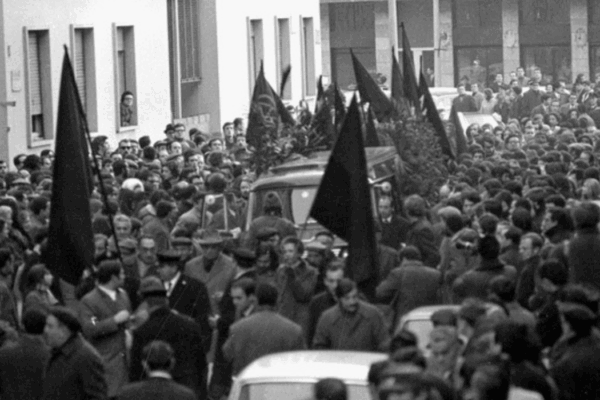
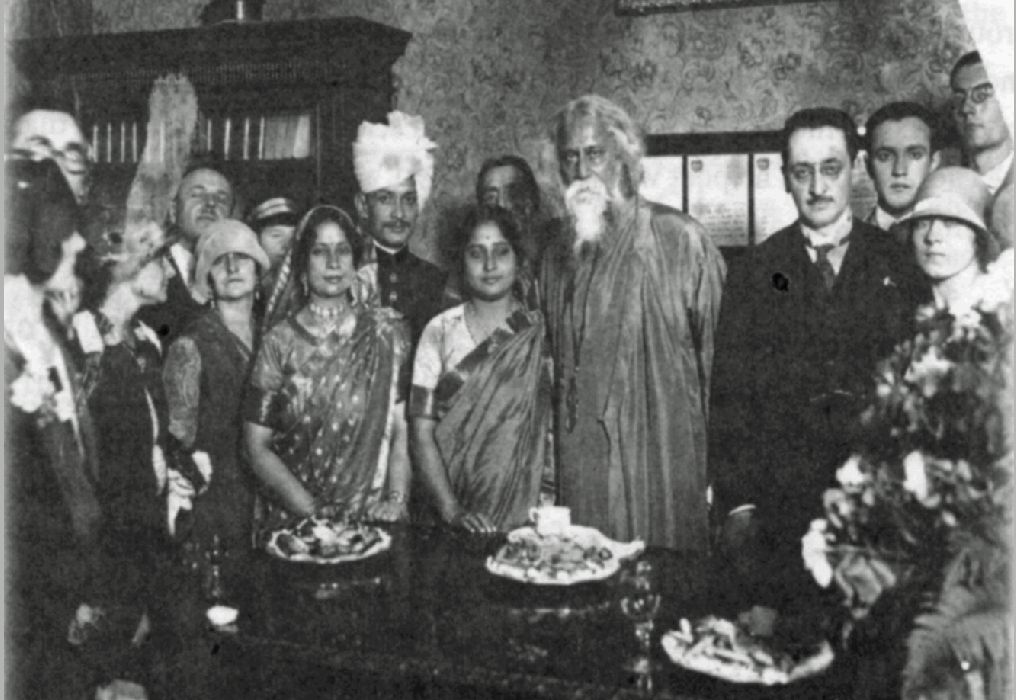
Image: Tagore at the University of Rome, 1926. Source: Rabindra Bhavan