In Italy, as elsewhere, the debate on the Israeli-Palestinian conflict increasingly connotes how Jews in the diaspora are seen and act in political, social, and cultural arenas. With identitarian and birthright narratives filling the political and intellectual debates, rhetoric has taken center stage. Many Jews around the world face the challenge and contradictions of navigating ethics and tradition within one country’s political space while participating, by proxy, in another. This process allows old tropes to reemerge, reignites fears, and steers resentments. We have asked Bruno Montesano, who has written extensively on the subject, to review a selection of recent books that, in our view, reflect a history of diversity and public engagement among Italian Jews.
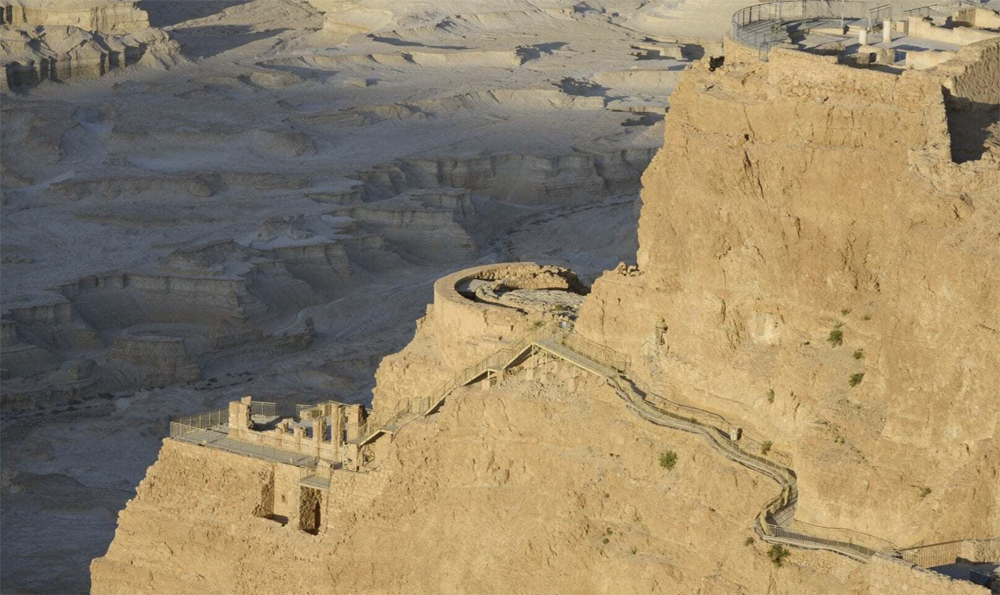
Image: Masada complex, built by the king of Judea Herod the Great, who reigned between 37 BCE and 4 CE., Israel
Jews at War: Between Community and Ethics
Jews at War is the title of a dialogue between Gad Lerner, former director of the main news program on Rai Uno (Italy’s flagship public television channel), and the Chief Rabbi of Rome, Riccardo Di Segni, published in 2025 (Ebrei in Guerra. Dialogo tra un rabbino e un dissidente). Although neither holds an official mandate, the two authors represent two important strands of the Italian Jewish world and two distinct approaches to the events in Israel and Gaza. Their divergence extends to how Judaism itself is understood and how much room should be allowed for criticism—not only of the Israeli government but also of Jewish institutions. In the book, Lerner appears as “the dissident.”
Since October 7, divisions that already existed within the small Italian Jewish community¹ (approximately 35,000 people) have deepened and become more visible in public debate.
Recently, tensions rose after a statement appeared in February 2025 in the leading national newspaper La Repubblica, titled “Italian Jews say no to ethnic cleansing.” This petition echoed a similar one published by a group of American rabbis in The New York Times. In Ebrei in guerra, Rabbi Di Segni argued that many signatories invoked their origins mainly to play “the good Jew,” setting a supposed desire for acceptance by broader society against the defense of communal belonging. Emphasizing communal concerns, Di Segni further attributes responsibility for the destruction of Gaza to Hamas for using civilians as human shields.
In his arguments, Rabbi Di Segni worries about parading the divisions within the Jewish community to the larger society. In his view, the Italian left’s support for the Palestinian cause and its criticism of Israel’s actions led many Italian Jews to gravitate toward the right.
Lerner, by contrast, worries that Israel has become a model for the international right: “an exclusivist society that imposes, if necessary by force and through a government endowed with full powers, its cultural and religious traditions on subordinated minorities.” He questions whether Prime Minister Meloni’s admiration for Israeli nationalism and supremacism truly offers protection for the Jewish diaspora. Lerner also highlights that Giorgia Meloni’s party, Fratelli d’Italia, descends from the Movimento Sociale Italiano (MSI), which was founded after fascism to preserve Mussolini’s political legacy in republican Italy.
While Di Segni recognizes that some elements of the Italian right’s support for Israel may serve ulterior motives—such as reinforcing anti-Islamic sentiments—he ultimately views their backing of Netanyahu as a reassuring signal for Italy’s small Jewish minority.
In contrast to these primarily political confrontations, Widad Tamimi’s autobiography Dal Fiume al Mare. Storia della mia famiglia divisa tra due popoli (From the River to the Sea: The Story of My Family Divided Between Two Peoples, 2026) offers a personal perspective. The daughter of an Italian Jewish mother whose family fled Trieste in 1939 to escape fascist persecution, and a Palestinian father who arrived in Italy as a stateless refugee, Tamimi explores the potential for unity between two peoples marked by dispossession, exile, and a shared pursuit of universal justice and freedom.
Her worldview is shaped by a radical humanism, rooted in the fundamental fragility shared by all people and the belief that no one can claim exclusive ownership over the land. Tamimi draws parallels between Palestinians and Jews—trauma, diaspora, and experiences of statelessness and refuge. Despite the power imbalance between Israeli Jews and Palestinians, she consistently rejects hatred, even when recalling the expulsion of her father’s family from Hebron during the Naqba (“catastrophe” in Arabic, indicating the displacement of the Palestinians in 1948), or the restrictions and humiliations faced by relatives in the West Bank. Even the devastation inflicted on families in Gaza by the Israeli army does not shake her tragic optimism; she continues to work tirelessly to help as many people as possible escape that ravaged land, relying on her own efforts, local partners, and international law.
Tamimi interprets the conflict through the lens of historical wounds and the potential for healing through justice and reckoning. She advocates confronting trauma, rather than fetishizing it—a process that otherwise traps individuals in cycles of pain, fear, and internalized violence. In Tamimi’s view, the State of Israel perpetuates trauma by fostering a constant sense of threat and transforming suffering into a legacy to be handed down. She observes that violence alters both victims and perpetrators across generations. Tamimi also cautions that Palestinians may similarly turn their wounds into barriers, allowing trauma to define their limitations and aspirations. In opposition to ethnic hatred, she contends: “what prevents two peoples from calling the same land home is the idea that belonging must be exclusive.”
Zionism, Colonialism, and Competing Narratives
Tamimi argues that acknowledging past wrongs is essential to seeing the enemy as human, rather than as an “abstraction.” In pursuit of this, many scholars and journalists have re-examined Israel’s origins to determine the extent to which Zionism can be understood through the lens of colonialism. Yet, beyond political asymmetries, the core moral reality remains: neither Palestinians nor Israeli Jews have anywhere else to go. This fact has only become more urgent after the destruction of Gaza.
In Fondata sulla sabbia: un viaggio nel futuro di Israele (Built on Sand: A Journey into Israel’s Future, 2025), journalist Anna Momigliano engages with Edward Said’s insight that “Israeli Jews are not white settlers of the stripe that colonized Algeria or South Africa,” but rather people driven by violence and persecution. Momigliano strives to portray Israeli society in all its complexity, rejecting simplistic dichotomies. She highlights that a substantial portion of Israeli Jews descend from communities expelled or displaced from Arab countries after 1948, challenging narratives that depict Israeli society as uniformly “white” or European.
Addressing the claim that Zionism constitutes colonialism, the historian Anna Foa adopts a nuanced stance in Il suicidio di Israele (The Suicide of Israel, 2024)—a position that has led to her ostracism in a community where she was long respected. Drawing on Derek Penslar’s work, she contends that Zionism’s colonial dimension emerges primarily after 1948 and becomes dominant following the 1967 occupation of East Jerusalem, the West Bank, and Gaza. Foa also dispels the misconception that Palestinians lacked a distinct national identity prior to Zionism. She further notes that socialist Zionism was not immune to exclusionary practices; many kibbutzim displaced or excluded Arab laborers.
Foa argues that Zionism was neither simply a reaction to emancipation nor its rejection; instead, it arose from diverse ideological currents and historical circumstances. The destination for Jewish settlement was hotly contested: “territorialists” promoted options such as Argentina and later Uganda, while “culturalists” viewed Palestine as a site for spiritual renewal. The slogan “a land without a people for a people without a land” was far less pervasive than is often claimed. Drawing on Dmitry Shumsky’s Beyond the Nation-State: The Zionist Political Imagination from Pinsker to Ben-Gurion (2018), Foa observes that, until the mid-1930s, much Zionist political thought entertained alternatives to the nation-state—a point also noted by Tamimi.
Historian Arturo Marzano, in Questa terra è nostra da sempre. Israele-Palestina (This Land Has Always Been Ours. Israel-Palestine, 2024), explores the complexities of Zionism. Marzano ponders that while Zionism exhibited certain colonial features in ideology and practice, it also possessed some differences. Since 1948, he argues, Israel has combined democratic institutions for its citizens with discriminatory structures that affect Palestinians in multiple ways. More broadly, it should be noted that, to varying degrees, the restriction or denial of rights to non-citizens and minorities is common in many nation-states, and racial hierarchies further shape access to material and symbolic resources. Citizenship establishes criteria of inclusion and exclusion that can become the basis of discrimination.
Historian Claudio Vercelli, in Storia del conflitto israelo-palestinese (History of the Israeli-Palestinian Conflict, 2025), maintains that Israel, in its particularism, reflects broader patterns of twentieth-century political experience. He argues that Israel emerged at the intersection of decolonization and settler colonialism: Zionism functioned as a national liberation movement against the British while simultaneously acting as a colonial force toward the Palestinians.
Vercelli warns that Israel is too often removed from the wider context of the “terrible century” of nationalist violence and treated as a singular case. This framing casts Israel as the embodiment of a supposed “surplus of ferocity,” a narrative frequently constructed from anti-Jewish tropes. After what many scholars and legal experts describe as genocide, Vercelli insists that Israeli violence is horrific enough on its own, without recourse to hyperbole or conspiracy theories—such as those linked to the Epstein files or speculation about Trump’s motives for attacking Iran.
Antisemitism
Many Jews experience the characterization of Zionism as colonialism as a form of demonization, feeling it erases or delegitimizes Jewish suffering. Similarly, accusations that Israel is a racist state are perceived as denying the Jewish people’s right to self-determination. As a result, criticism of the state—not just its government—can be framed as antisemitism. In this perspective, anti-Zionism is cast as a modern incarnation of traditional anti-Jewish hatred. These issues are explored by semiotician Valentina Pisanty in Antisemita: una parola in ostaggio (Antisemitic: A Word Held Hostage, 2025).
Pisanty begins with a reference to Humpty Dumpty in Lewis Carroll’s Through the Looking-Glass: the meaning of words is determined by those in power. Accordingly, the term “antisemitism”—popularized by Wilhelm Marr in 1879 with his Antisemitic League—has undergone a complex history and, over the past thirty years, has been redefined by the Israeli right to shield its policies from criticism.
Pisanty revisits David Engel’s influential 2008 essay, Away from a Definition of Antisemitism: An Essay in the Semantics of Historical Description, which sparked significant debate in the field. Engel’s “contextualist” theory rejects the notion of a continuous, unbroken history of antisemitism. Instead, he argues that the motives for violence against Jews have varied widely across time and place, making it misleading to subsume all instances under a single, ahistorical definition. For Engel, it is the specific contingencies—rather than a timeless human impulse—that matter most.
Pisanty observes that, while it is “undeniable that Jews have been subjected to physical and symbolic aggression across the centuries,” it is far less certain that one unbroken thread connects these experiences. Jews are not a monolithic or static group, and violence against them has targeted vastly different communities—from the Polish shtetl to assimilated Jews in Western Europe. Just as anti-Jewish hostility relies on an abstract, essentialized image of “the Jew,” there is a risk of similarly essentializing antisemites by projecting them outside of history into a metaphysical realm.
She identifies the heart of antisemitism as the projection onto “the Jew” of a phantasmatic stereotype, composed of traits drawn from a long archive of religious and secular tropes—deicide, parasitism, usury, rootless cosmopolitanism, conspiracy, double loyalty.
In contrast, anti-Zionism is a political phenomenon—sometimes intertwined with classic antisemitic tropes and sentiments, but rooted in different motivations. Pisanty calls for a comparative approach to understanding various prejudices and cautions against substituting intellectual debate with censorship, as exemplified by the International Holocaust Remembrance Alliance (IHRA) definition of antisemitism.
Anna Foa’s recent book, Mai Più (Never Again, 2026), advances arguments in line with Pisanty. Foa distinguishes between Christian anti-Judaism, rooted in supersession theology, and modern racial antisemitism. She cautions against treating the Nazi-Fascist extermination as the exclusive legacy of the Jewish people, arguing that its memory must serve as a warning against all genocides and injustices. Like Tamimi, Foa urges engagement with the present, rather than fetishizing the past. She rejects both the competition among victims and the myth of eternal antisemitism, seeing in the trivialization of the genocide in Gaza a repetition of the denial that has often accompanied memory of the Shoah.
Like Lerner, Foa identifies the seeds of a new antisemitism in the conflation of Judaism with Israel—a notion promoted both by some critics of Israel and by the alignment of many Jewish institutions with the political right, in Italy and elsewhere. She warns that inflating accusations of antisemitism can undermine the meaning of the term, making it harder to distinguish genuine prejudice from political disagreement. As violent attacks against Jews increase, Foa warns that prioritizing the fight against antisemitism over solidarity with other vulnerable groups risks further isolating Jews.
In The Suicide of Israel, Foa had already highlighted the deeper historical roots of this isolationist stance. Echoing historian Omer Bartov, she notes that, in Israel, the mass protests against authoritarian judicial reform failed to confront the systematic assault on Palestinians in the West Bank. Foa contends that this moral myopia and a pattern of flawed alliances have placed Israel on what she calls a suicidal path.
Foa ends her book by outlining a post-Zionist vision: overcoming the dilemma between a Jewish state and democracy requires recognizing all inhabitants of the land as free and equal citizens in their diversity. But is a shift toward “truth and reconciliation” possible?
Coexistence
Claudio Vercelli urges us to move beyond the “zero-sum game” of antagonistic—though asymmetrical—identity politics. Achieving this, he argues, requires examining the historical trajectory that produced the current impasse.
Momigliano examines the spiral of enemy dehumanization that followed the assassination of Itzhak Rabin by a right-wing Israeli extremist and the subsequent collapse of the peace process. Yet she remains skeptical of nostalgia for Rabin, the architect of the Oslo Accords. Marzano, meanwhile, criticizes Rabin’s Labor Zionism for clinging to the idea of a permanent Jewish majority—a project that has resulted in the untenable political and administrative fragmentation of Palestine.
For these Italian observers, the path to coexistence starts with rejecting the ideal of an ethnically or religiously homogeneous state and cultivating the ability to see oneself through the eyes of the other. Momigliano highlights the perspectives of Palestinian citizens of Israel, such as Rula Daoud, co-chair of the Arab-Jewish grassroots peace movement Standing Together.
Similarly, Vercelli argues that identity politics and nationalism on both sides have led Jews and Palestinians to deny each other’s existence and to conflate their ruling classes with the entire population.
Vercelli criticizes the impoverished state of public debate, which often repeats illusory claims like the “impossibility of negotiation” between supposedly irreconcilable communities. He argues that this mantra diverts attention from substantive socio-political analysis. For Vercelli, the crucial factors are not national identities, but the internal divisions within each group and the dynamics of power and class. He also connects the international community’s paralysis over Palestine to a global context marked by destabilization, unilateralism, belligerence, and the glorification of ethno-racial identities.
By contrast, Widad Tamimi maintains that “from great tragedies, even the most insurmountable obstacles can become unexpected opportunities for inspiration and progress.” She envisions the land from the river to the sea—currently a testing ground for advanced military technologies and methods of control—being radically repurposed as a laboratory for coexistence among diverse ethnic and religious groups, protected by a renewed international law committed to universal human rights.
For Tamimi, the horizon that emerges is that of a non-state: transcending the “hegemony of peoples” in favor of universal justice—a vision she sees as not only desirable for Israel and Palestine, but essential for the future of democracy everywhere.
- Jewish minorities on the Italian peninsula lived under many different ruling systems: empire, city-state, principate and kingdom, theocracy, monarchic nation-state, dictatorship, and democratic republic. In each era, communities created their own forms of governance. After the creation of the Roman ghetto, they produced the equivalent of a constitution. The Lateran Pacts of 1929 established Catholicism as Italy’s official religion. Following the Pacts, Jewish communities from Naples to the Northern border were centralized: small communities were required to merge with larger ones, resulting in a uniform system under the Regime’s control (Falco Law, 1930). Jewish citizens who did not want to register with a community as required, had to abjure. Each municipal community had a representative reporting to the “Union,” which was the government’s main interlocutor. Representatives were selected and/or approved by the Fascist government. After the war, the Union of the Italian Jewish Communities adopted an electoral system, and in 1987, it was reorganized as a national council elected by the members of each community to interface with the State institutions on matters relevant to Jewish life in Italy. Of an estimated 35-38,000 people who identify as Jewish, approximately 21,000 are formal members of Jewish communities.