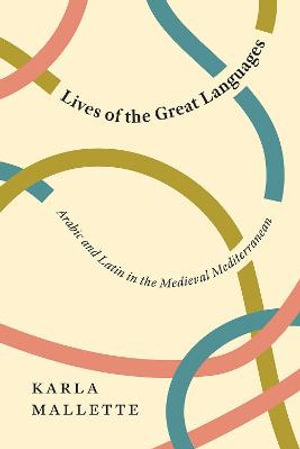
On ‘Lives of the Great Languages: Arabic and Latin in the Medieval Mediterranean’ by Karla Malette (The University of Chicago Press, 2021)
Lives of the Great Languages is – and does – many different things at once, but one thing it is not, as the title suggests, is a simple biography of Arabic and Latin, recounting chronologically their births, lives, and deaths. Instead, what we are presented with is a far more complex and interesting project. While it does indeed tell the story of these languages’ lives – albeit through various case-studies as opposed to a singular narrative – it does so in service of a broader exploration of the nature of the Cosmopolitan Language, and how it negotiates power, territory, status, and utility with its vernacular counterparts.
In the first line, Malette describes her book as “in a sense, a tragedy.” She is eulogizing not just languages that are dead, those being Quranic and Classical Arabic, and Latin, but also a kind of language that is dead: the Cosmopolitan Language. This term denotes a much more specific concept than simply a language that many people, even across cultures, all speak. A language that Malette describes as Cosmopolitan – or sometimes (confusingly) as Alexandrian– is a language that is rarely, if ever, anyone’s first language. It is instead one that must be learned and acquired with time and great effort, and thus enjoys an exalted status within literature, and as is discussed later in the book, religion. Those who adopt these Cosmopolitan Languages gain access to a new plane of expression and exchange of knowledge, one that is not bound provincially, but exists within the larger networks of trade and commerce and travel. This kind of language stands firmly in contrast to the vernacular: a local language, generally a speaker’s first, that is reserved for the activities and communication of everyday life. As such, it doesn’t enjoy the same exalted status of the Cosmopolitan in the broader, increasingly connected Medieval Mediterranean world. (That is of course, until writers such as Dante help to elevate them).
 What emerges is a portrait of a dynamic and pluralistic linguistic landscape in the Medieval Mediterranean, in which the Cosmopolitan Languages and the vernaculars develop complex relationships of exchange and of competition. And equally complex to the interrelationships of languages are the relationships between the languages and the featured writers of the book. It seems things are rarely straightforward when it comes to the social and literary politics that permeate much of the Medieval literary and intellectual world. Sibawayhi, for example, is used to tell a story of the rapid spread of Arabic in its early life, carried across land and sea within the Quran. During this time, Sibawayhi would write one of the first grammatical treatises on the language, which drew much controversy at the time, one not-insignificant reason being that he himself was not an Arab. We find this recurring motif throughout the story; these writers are not of these Cosmopolitan Languages in the way that we feel of our native languages today, rather, through significant effort they earn themselves in. Dante, too is a natural early case-study in the book, who wrote his unfinished discourse De Vulgari Eloquentia on precisely this subject of the relationship between Latin and the vernacular languages as literary tools, and in search of the ideal universal vernacular (which he would not find, and for his Commedia would instead adopt his local Florentine vernacular).
These examples of Sibawayhi, Dante, Petrarch, and others do well to familiarize us with this world, fraught with complex social and political linguistic dynamics. Later chapters focus on the translation movement between Arabic, Latin, Greek, and other Mediterranean languages of the era, exploring the interactive behaviors of these Cosmopolitan Languages – how they through translation, develop themselves by importing not just terminology but structure and literary style. One vignette covers the Arabic translation from Greek of Aristotle’s Poetics. In this translation, some terms are significantly altered from the original Greek in order to better relate to the Arabic literary tradition, which would affect the Latin understanding of the text when translating from the Arabic (this is a simplification of the chapter’s thesis). A fascinating chapter covers the idea of the Lingua Sacra, that language that adopts an almost transcendent ontological status as that which grants some kind of access to the divine. The final chapters cover the languages’ decline, the Lingua Franca, and the first printed Quran.
The structure of the book that Malette has developed makes for a unique approach to the subject. Each chapter, as described, is a vignette of a writer and his encounter with language(s), and while these are individual stories about people, they are tiles in a larger mosaic that tells a story whose central characters are in fact the “Great Languages”. Whereas often language is taken as the medium through which to access the literary or non-literary textual world of history – a philological approach – she instead uses the various textual histories of the Mediterranean as the medium through which we can analyze the languages themselves. This “may appear atypical, even eccentric,” Malette admits in her introduction. This isn’t pure philology, but rather philological tactics employed for a kind of socio-historical linguistics.
As interesting as the framing of the book that Malette uses are the ways in which she frames language itself. For the most part, languages are framed through two metaphors that Malette employs. From the first chapter, the book introduces its fundamental metaphor of languages as personified “agents of historical change” that behave as competitive and cooperative actors in their various environments. They travel, evolve, communicate amongst themselves, they grow old, they die. In this way, we see language not as a medium through which people talk and write, but rather the talking, writing people as mediums through which the language lives. But this kind of personification is not the only metaphor used (in fact, later in Chapter 8, Malette presents an argument against the effectiveness of this personifying metaphor).
The second metaphor presents the Cosmopolitan Language as an environment, a territory that a writer gains access to by means of learning and then refining their ability with the language. The vernacular is located in the immediate. It presents little opportunity beyond the confines of its physical territory and the subject matter of everyday activity. The Cosmopolitan language escapes this material confinement to bring one into the wider world of respected intellectualism, as it does escape temporal confinement to enter the literary canon, or even achieve some sense of atemporality, as with the lingua sacra.
And so we have a dual-narrative. One in which the language is the agent, and we people simply the means through which it travels and is introduced to others, shares with others, wars with others; in this way, we become the language of language, its means of communication and interaction. The second framing places us comfortably back in the center of things, where language becomes a territory, an entirely new place for us to enter and engage in, rooting us in a cross-cultural and supranational realm of discourse and art.
Of course, this is only a story of the Medieval Mediterranean, though at times extending into the early-modern and modern era. This picture of Cosmopolitan Languages traveling, encountering vernaculars, all bearing different kinds of social and political baggage, seems to bear little resemblance to the world in which we find ourselves today. Malette describes our current system, with reference to Europe, as the (European) national-language model; Italians speak Italian, the French speak French, the Lithuanians speak Lithuanian, and so on. This is what happened to the world of language and linguistic identity as the Cosmopolitan Languages, and with them the very idea of the Cosmopolitan Language, died and were succeeded by the vernaculars of the world. The national language becomes the language of that country’s literature, film, government affairs, casual conversation, in many cases even its religious practice.
But I think it’s worth making the point that this idea of our current global linguistic structure is exactly that: an idea, and one that more often than not struggles to map onto the actual world we live and speak in. This is less a description of the present reality than it is a constructed notion in service of justifying and solidifying the existence of a nation-state and the nation-state model. In many cases, this model is successful in that it coincides well enough with reality such that it doesn’t cause too many issues. Italy is in fact, mostly Italian-speaking, a feature that distinguishes it from the rest of the European nations and is self-defining. (Naturally, there are exceptions even here. The Italian tennis player Janik Sinner speaks German as a first language, as do most from his province of South Tyrol, where, as per a 2024 census, only 22.6% of the population speaks Italian. Countries with a stronger presence of linguistic diversity have struggled with the move towards nation-states and national languages. South Asia provides a perfect example: the 1971 civil war between Pakistan and Bangladesh (at the time East Pakistan) was in large part caused by the attempt of the Pakistani government to establish, thus impose, the unifying national language of Urdu, which most of the population did not speak. In fact, even today, not even 10% of Pakistan’s population of 250 million speaks Urdu as a first language. Further complicating the matter, I, as an Urdu-speaking Pakistani, would have a far easier time communicating with a Hindu-speaking Indian than with a fellow Pakistani who only speaks Sindhi (or Punjabi, or Balochi etc.)
In speaking of Malette’s work and its implications for the current world, another question arises regarding the potential successor, perhaps even the perfector, of the Cosmopolitan Languages of old: English. English is by far the most widespread language in the world, but of course, Malette’s definition of a Cosmopolitan Language is far more nuanced than simply a widely spoken language. If we recall, it is a language that is rarely anyone’s first, is acquired through study, grants one access to a wider connected world of knowledge and communication, travels on those networks of trade and migration, and generally enjoys an exalted status relative to the surrounding vernaculars. This is a concept clearly rooted in its historical period, not so easily imported into the present day. Whether or not we can see English in these terms depends on how flexible we are willing to be with Malette’s definition. Technically, English is disqualified from the outset, as it is in fact, a vernacular, the first language of around 400 million people, and is hardly a language reserved for any specific artistic practice. It is a language of anything and everything that people do. However, in other ways, it does resemble Malette’s characterizations of the “Great Languages.” An estimated 1.5 billion people speak English today, but for the vast majority of them, English is a second language. For everyone from a country where English is not the national language, it serves as a means by which they can escape the “linguistic regime of the territorial state,” and access a wider world in which English serves as a common tongue to bridge the linguistic divide between cultures, countries, and peoples. Furthermore, as with the Medieval Cosmopolitan Languages, English appropriates words and ideas from the other languages it encounters in its global expansion, and creates an exclusionary effect in which those who do not learn it are excluded (though less and less) from the globalized world.
On a final note, what has dramatically changed regarding linguistic diffusion is the manner through which languages and information travel, via increasingly immaterial routes. What Malette makes reference to, though does not thoroughly explore as an explicit part of her project, is how the travel and spread of influence of these Cosmopolitan Languages was facilitated by material economic networks. While her framing of language is often as these abstract, theoretical territories that consist of networks spanning empires, they are in fact substantiated by very physical networks of trade and migration. Political, economic, and imperial ambition generate new routes of movement, of which Malette’s linguistic maps are born. The situation today is quite different. With the advent of the internet, the exchange of information and ideas has become increasingly untethered from the networks of commerce and military expansion (the latter having radically decreased in the last century). Language moves through the digital dissemination of culture, through books, films, tv shows, texting, memes, TikToks, which new scholarship also demonstrates to be major factors in the evolution of these languages.
However, while the internet often receives substantial credit for altering human behavior and interaction, these developments of the past century have not rendered Malette’s insights any less relevant, nor confined them to the Medieval or Mediterranean. As previously mentioned, Malette frames languages in terms of theoretical territories and networks. While these are facilitated by material territories and networks, their abstract nature gives them a certain flexibility and allows them to map just as well onto the digital world. Social media, for example, simply becomes another kind of space where languages travel and encounter one another, alongside older routes of trade and migration. More parallels between us and our Medieval counterparts become increasingly apparent as one reads the book. The linguistic choices we make remain loaded with social politics. While there is less competition as to which is the dominant Cosmopolitan Language of our time, in many parts of the world, languages still compete, struggle to maintain relevance, and die out against national languages. Even these national languages are often in competition with English in its continued expansion.
In the end, what we see today is a continuation of the same story of people moving around and talking to each other, even if now they do so in the digital world as well as the physical. While modern languages and linguistic behavior cannot be perfectly wedged into Malette’s framework, what her work does do is provide a new and fruitful way with which to approach the understanding of language politics today – language as a territory, agent, and object of history. Through an exploration of the Medieval Mediterranean, she has given us a set of tools and a novel framework to begin to unravel this intricate web of politics and social behavior, and technology that defines language in the modern world.