On Yom Kippur and my favorite prayer, which is also a poem.
Everyone has a favorite prayer—even those of us who don’t pray. My favorite prayer is four lines long, and it is in both the Rosh Hashanah and the Yom Kippur liturgy. To me it’s a writer’s prayer; it asks God for the ability to speak, to express oneself, to find words that have meanings.
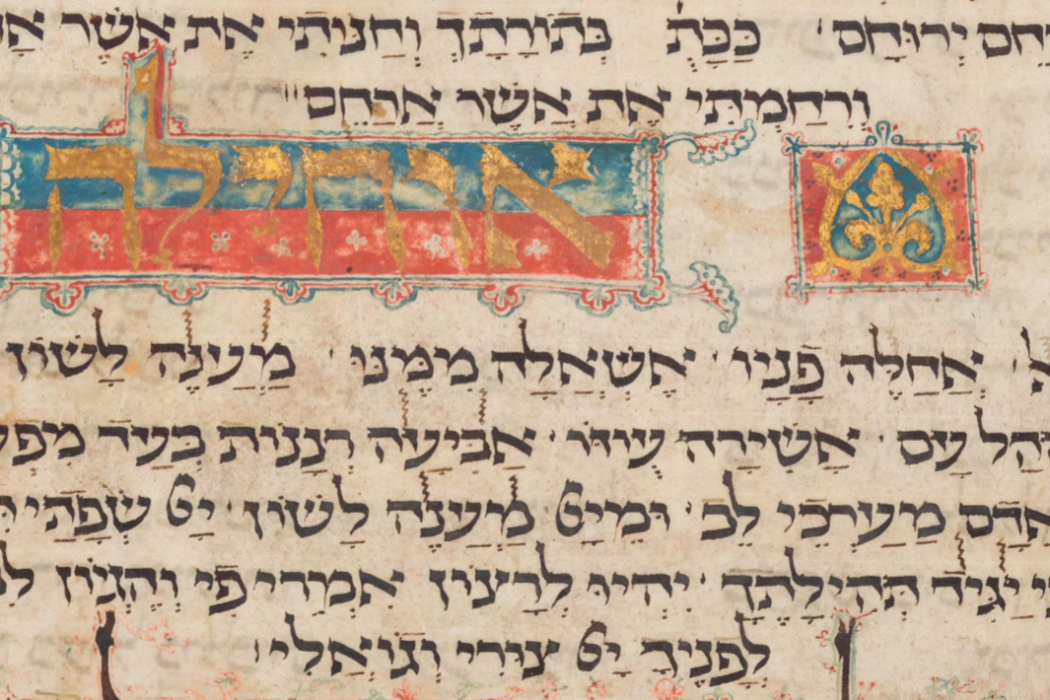
I love finding it each year. I wrote about this in the past, but I am thinking about it again. Here it is, on the bottom of the page in the first image below.
Even if you don’t read Hebrew you can see how the same letter—lamed—with its swirl upward and to the right, defines the first three words of the poem and gives it its music.
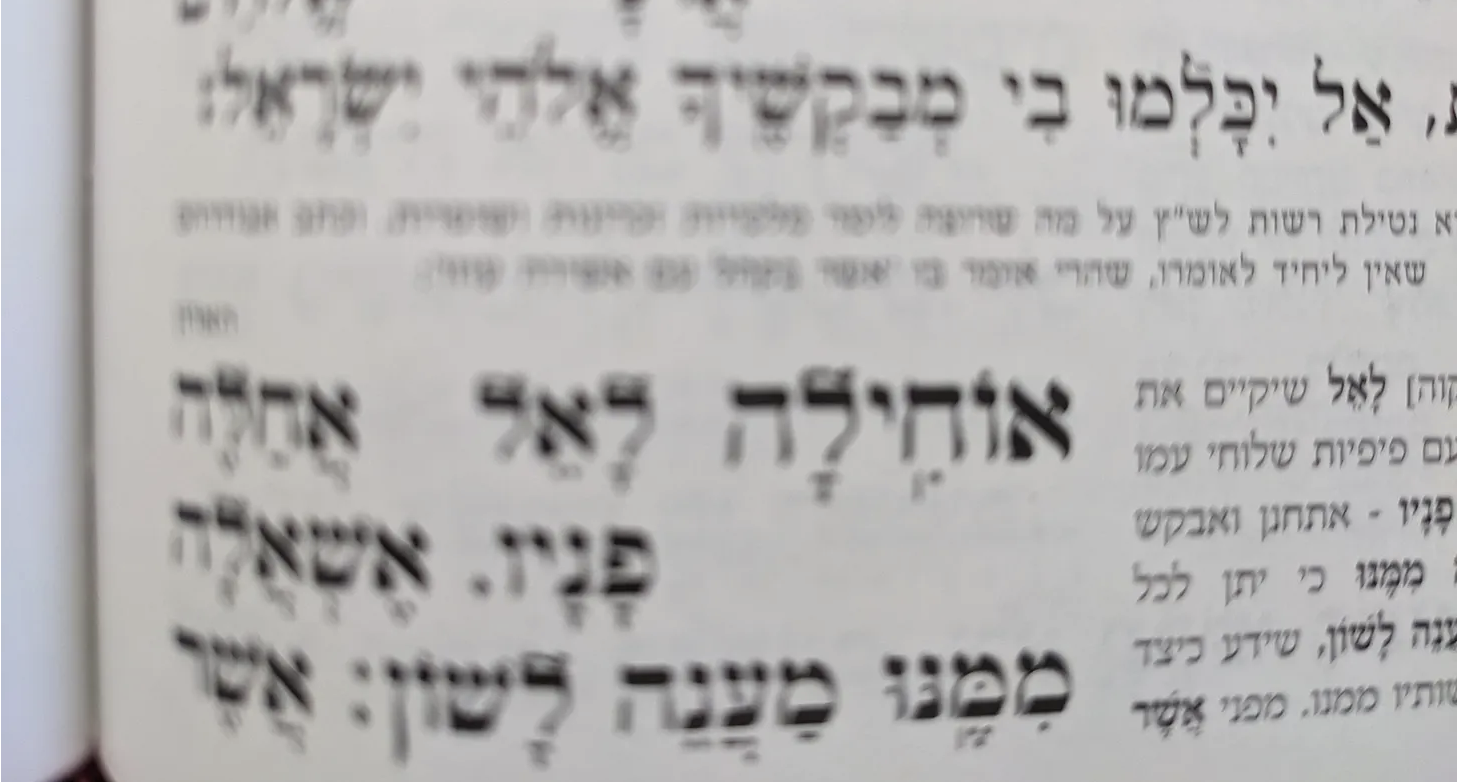
Ochila La’el appears at the bottom of the page. The last three bolded lines.
The rest of the poem, in bolded letters. Each verse ending is represented by a colon.
The problem with trying to tr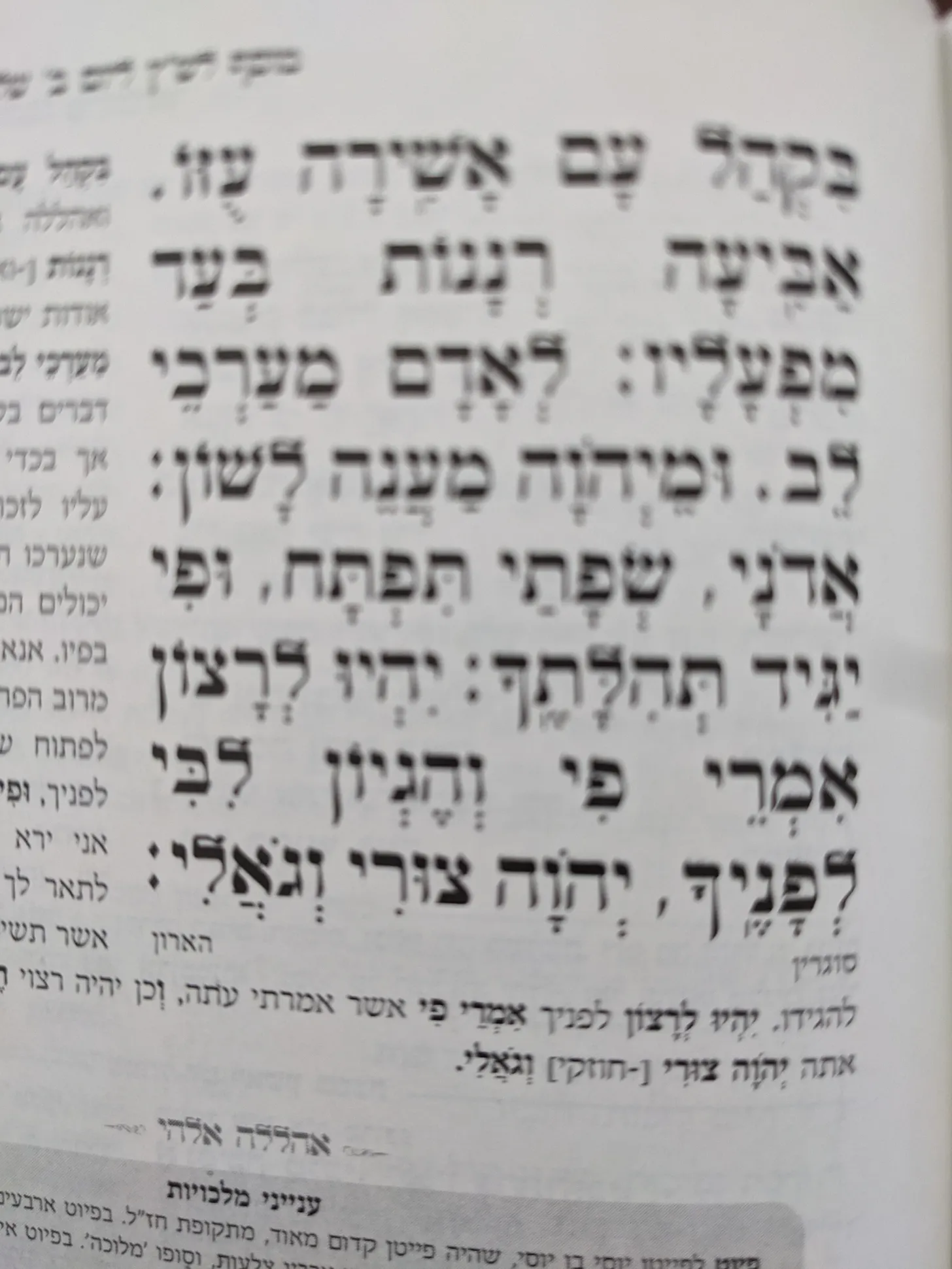 anslate אוחילה לאל –“Ochila la’el” — is that what is beautiful about it in Hebrew is how it sounds—all those “l” sounds, those lamed sounds, in a row, threading throughout four lines. It is a poem that is sung, and it’s hard to separate the sound and the meaning.
But I think there are two solutions to this problem. And just so all of this is easier to follow, here it is in Hebrew, typed out. (Yes, this is a bilingual edition of the newsletter!):
אוֹחִילָה לָאֵל אֲחַלֶּה פָנָיו
אֶשְׁאֲלָה מִמֶּנּוּ מַעֲנֵה לָשׁוֹן
אֲשֶׁר בִּקְהַל עָם אָשִׁיר עֻזּוֹ
אַבִּיעָה רְנָנוֹת בְּעַד מִפְעָלָיו
Borrowing From the Rest of the Bible
For example, one verse in this prayer, which I especially love, is a complete lift from Proverbs 16: 1. Here is that verse in The Jewish Publication Society translation from 1985, which is a widely used translation:
“A man may arrange his thoughts, But what he says depends on the LORD.”
One problem with that is that it omits the tongue, which in Hebrew is both a body part and another word for language. In Robert Alter’s recent translation, Proverbs 16:1 reads:
Man’s is the ordering of thought,
But from the LORD is the tongue’s pronouncing.
Ahah. Including the tongue is an old strategy, and I can’t imagine a reader not knowing that the tongue is part of the verse. The King James translates it this way:
The preparations of the heart in man, and the answer of the tongue, is from the LORD.
I confess—I love “answer of the tongue” because it captures the Hebrew ma’aneh lashon.
Translations—in Words and in MusicThere are a growing number of singers who have recorded this prayer, this song, this gorgeousness. As Rosh Hashanah approaches, I have been listening to their interpretations. Even if you don’t understand a word of Hebrew poetry, you can understand the clear and plaintive request to God.
But first, here is a translation of Ochila La’El from Rabbi Jonathan Sacks z”l, who was a beautiful writer, and who completed a translation of the entire High Holiday liturgy shortly before his death. In all honesty, I don’t know how I feel about the “shall” that Rabbi Sacks goes with. To me, this prayer feels more intimate. And the lineation here makes it feel longer than it does in Hebrew, but then, English is always longer than the Hebrew original.
I shall await the LORD, I shall entreat his favor,
I shall ask Him to grant my tongue eloquence.
In the midst of the congregated nation I shall sing of His strength;
I shall burst out in joyous melodies for his works.
The thoughts in man’s heart are his to arrange,
but the tongue’s eloquence comes from the Lord.
O LORD, open my lips, so that my mouth may declare Your praise
Image: Ohila la-El in the Amsterdam Machzor (1250s)