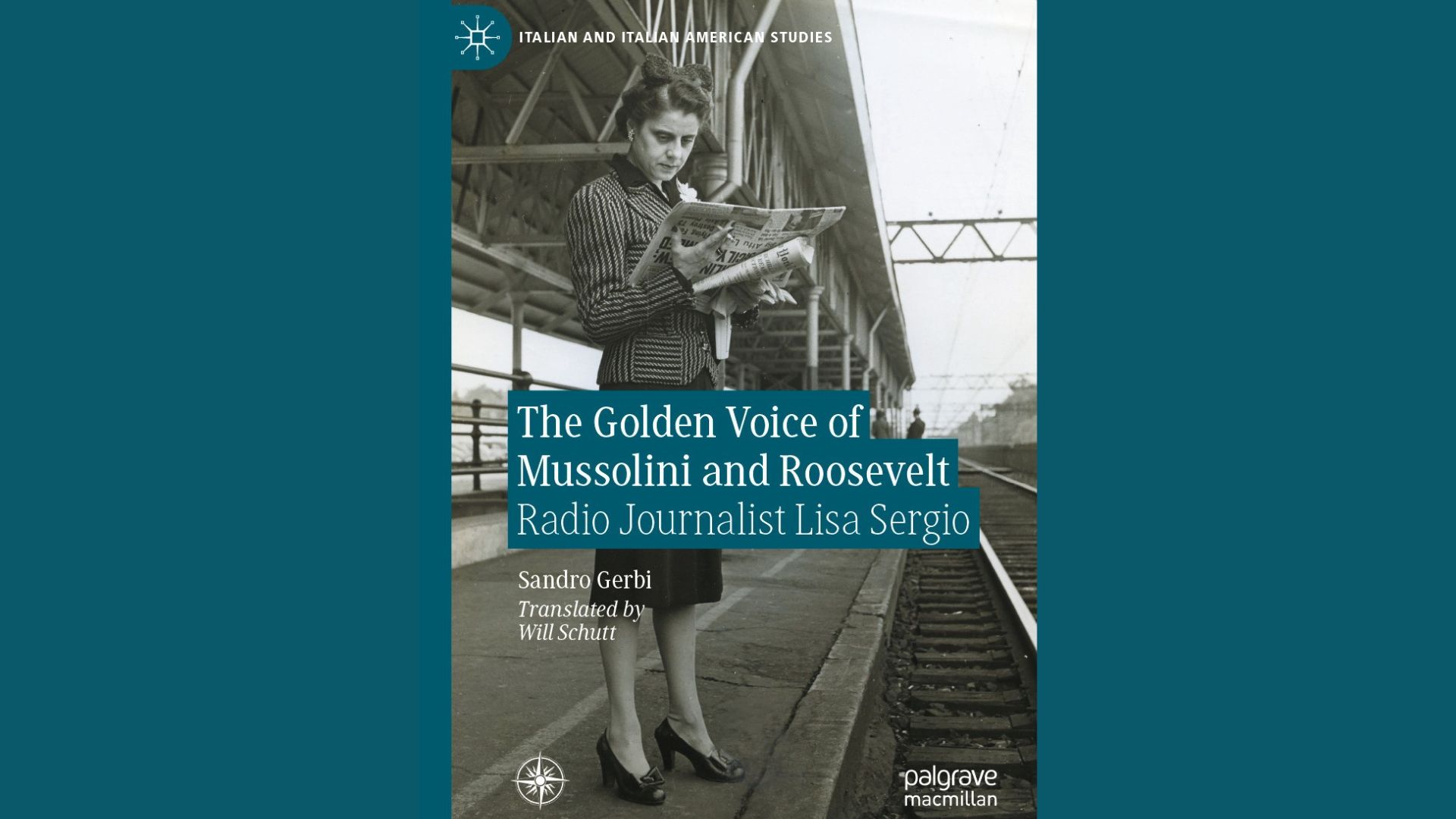
Reviewed: The Golden Voice of Mussolini and Roosevelt: Radio Journalist Lisa Sergio by Sandro Gerbi (Palgrave Macmillan, 2026)
Florence has a rich history of being an idyllic Italian summer playground for various insufferable contingencies of the Anglosphere. Now it is overrun by American study-abroad students for whom the city serves as a close train ride to Pisa from which to catch Ryanair flights to Berlin for Oktoberfest and Dublin for St. Patrick’s Day, but not so long ago around the mid-nineteenth century, it was a hub for British and American aristocrats and artists:
“Florentines called them “anglobeceri” [Anglo-boors], an amiable dig at their misguided efforts to pronounce Italian words. According to Giuliana Artom Treves, an expert of this phenomenon, “English was a term applied to every foreigner who came to Florence. ‘The English have arrived,’ the porter would say to the hotel manager. ‘But I’m not sure if they are Russian or German.’” On the other hand, didn’t someone write that in the middle of the nineteenth century Anglo-Americans made up a third of all city dwellers?”
This was the same time that Lisa Sergio, protagonist of Sandro Gerbi’s recently-published biography: The Golden Voice of Mussolini and Roosevelt: Radio Journalist Lisa Sergio (Palgrave Macmillan, 2026) began her journalism career. Our Lisa got her start working for a couple of local newspapers that catered to this expatriate community. No account of her fails to mention how attractive and intelligent and cigarette-addicted she was. But that seems to be the beginning and the end of consistency when it comes to who exactly Lisa Sergio was, and what exactly she got up to. So, who was she? Depends who you ask.
If you asked her herself, which many interviewers often did, Lisa Sergio would tell you that she was the first female voice on Italian radio. A reluctant fascist during Mussolini’s rise to power, and an ardent antifascist following her move to the United States, right before the outbreak of the Second World War. She was born in Florence in 1905, she was daughter to a southern-baron father who descended from ancient Roman nobility; on her mother’s side, she was a distant cousin of Franklin Delano Roosevelt. Her family life seems to have been turbulent, a mother who would leave frequently for work and a father who left for good. But that did not stop her from a journalistic career in Florence that then led to a brief stint in archeology. One day, working at a museum, she looked up to find herself towered over by Mussolini himself, who singled her out to ask her about the exhibitions he had been installing. Eventually she found herself an English-language radio broadcaster (she was revered for her perfect English accent) in the Italian Ministry of Propaganda under Mussolini’s government, notably during its attempted conquest of Ethiopia. This however, was done reluctantly, as deep down she was appalled by the behavior of the regime and its colonial exploits. In fact she was practically coerced into the job, referencing the threatening presence of secret police in cars outside her home. As a radio broadcaster, it was in fact her who first established the word “axis” as a political term. This was also around the time Sergio began, quite subtly, her work as an antifascist. She would purposefully alter broadcasts, veering off-script, omitting sections she disagreed with such as those referring to Ethiopians as “savages.” These discrepancies came to be noticed by Mussolini, who on account of her unreliability and suspected antifascism, ordered her dismissal. A statement of resignation was presented to Lisa Sergio by a superior of hers (and Mussolini’s son-in-law), Galeazzo Ciano, demanding she sign the document. Lisa bravely refused, declaring she had no reason to resign.
“‘Miss Sergio, I see the reason: you have betrayed Il Duce and our cause. Consider yourself lucky. If I were you, I would have had you shot a long time ago.’ She replied: ‘You will be the one shot, not me. Remember that.’”
Despite her ardent refusal to resign, she was pressured out of the job through intimidation by the secret police, who tapped her phones and had her followed. Once word got to her that she was likely to face imprisonment or some kind of punishment, she fled to America. There she was able to freely espouse her antifascist sentiments, resuming a career in journalism and broadcasting, settling down, and eventually passing away.
That’s more or less what Lisa would tell you. If you asked the author of this biography, Sandro Gerbi, or most other Lisa Sergio researchers, most of what you’ve just read is likely completely made up. Aside from being a fascist-antifascist-journalist-writer-socialite-activist, Ms. Sergio was, no less than she was any of those things (arguably more than she was any of those things), a habitual liar. Lisa Sergio was not the first female broadcaster in Italy. Her father was almost certainly not of any ancient nobility — Agostino was an idle, dissolute Neapolitan who lived off family money, suffered from what was probably syphilis, fired a gun at Sergio’s mother (missed), and died alone and estranged. Her mother was almost certainly not related to Franklin Delano Roosevelt in any way. Gerbi finds it very unlikely that Sergio’s account of meeting Mussolini in the museum is true. Her story of being intimidated by the state into accepting the broadcasting job is likely untrue in favor of the idea that her mentor and friend Marconi probably put in a good word for her and landed her the gig. It is unlikely she coined the term “axis” (and even if she did, the biographer notes that he does not find this at all remarkable). There is little evidence to support the idea that she was an undercover antifascist during her time at the Ministry of Propaganda, and instead we find a strong record of pro-fascist sentiment prior to her move to America. But then what of her forced resignation? Records and testimony indicate it was more likely that it had something to do with an apparent affair she was having with the aforementioned Galeazzo Ciano, an affair she had the habit of boasting about publicly. This coupled with the fact that OVRA (the Fascist secret police) records show they were concerned about how freely she discussed political matters with foreign journalists, tells a different story to Sergio’s. She did go on to be a vocal antifascist activist a few years into moving to America, but the authenticity of those sentiments naturally remains suspect. It’s all a bit suspect when it comes to Lisa.
The book is a biography of a woman with a habit to self-aggrandize and rewrite her own history; almost every sentence that hasn’t been verified by research is prefaced with a word like “allegedly” or “supposedly”, attesting to her character as an opportunistic liar. Or each episode will be followed with a paragraph about why her telling of events is likely untrue and then present a more probable, and often more unexciting, explanation. Information regarding Lisa that hasn’t come from her own retellings often comes from the files OVRA kept on her when she was under a degree of surveillance, or from the FBI, who also kept files on her having initially suspected her as a Fascist agent and then in later years suspecting her as a communist. She probably wasn’t a communist, potentially some kind of progressive, maybe she was at some point a fascist, or an anti-fascist, maybe both, or perhaps neither in any meaningful sense.
This mix of truth and fiction, the general lack of certainty about anything, is really what gives both Lisa and this book their charm. Gerbi has evidently done his research, yet all too often is still left with no one on whom to rely but Ms. Sergio and her retelling of things. In these cases he writes things like: “…all we have to go on is her own, ever murky version of events.” or “Assuming and not conceding that this reconstruction of events is true…”. His use of the word “conceding” is revealing of the conflict at the heart of this book between the biographer and his mythomaniac subject. The vain efforts of the historian raging against subjectivity. This is for the best. The Lisa Sergio story is fascinating precisely because of its ambiguous nature, that we can’t be certain of the facts of her life. Too much “objective” information would risk ruining that. There is a profound value in reading the way someone writes or hearing the way they talk about themselves. Insight into someone’s self-generated narrative of their life is as relevant and valuable in a historical sense to a fact-based outline of external events. There is a way of viewing history not as a successive chain of universally-true events but rather a constellation of individual subjective experiences, the sum-total of which generates what we conceive as our collective past. Even through this haze of truth and fiction, it’s hard not to love Lisa. As readers we fall victim to the same charisma that allowed her to hustle and climb the various professional and political ladders that she did.
Finally, adjacent to the story of Lisa Sergio is the one of political speech and propaganda during this era. She worked at a time where technological development led to an evolution in the ways that political leaders communicated with their audiences. The advent of radio, and later television, meant that you no longer had to communicate with large numbers of people exclusively through rallies. This wasn’t just an improvement in convenience but had a qualitative effect on the character of the speech itself; the way you speak to a large crowd isn’t necessarily the same as the way you can communicate with families in their living rooms. During her antifascist era Sergio remarked on the differing approaches to political speech that characterized Mussolini’s Fascist government as opposed to Roosevelt’s; how the fascist uses large audiences and the roar of the crowd to sweep people into a fervor, versus the approach of televising “fireside chats” in which people consume political speech in a living room with their families, the president present as a softer paternal authority. Things have changed now. In an Italian piazza your general stood atop a balcony, and you among thousands of your fellow comrades all stood lost in some infantile fantasy of being Roman soldiers. Across the pond you sat in your living room, your dear and wise presidential father sat in the armchair smoking a cigar and telling you aphorisms like “the only thing we have to fear is fear itself.” Now with twitter and the like, the consumption of political propaganda is no longer a social experience; a lot of political communication moves instantaneously from screen to mind, becoming a voice at the back of your head. Now you lie in bed while a lobby-funded demon leans over you and whispers vile dreck into your ear about immigrants and homosexuals.