Sari is the executive director of the Public Committee Against Torture in Israel, a human rights organization protecting Palestinian detainees and others at risk of being subjected to torture and mistreatment. She is the co-founder and former executive director of Gisha-Legal Center for Freedom of Movement, the Israeli human rights organization promoting freedom of movement for Palestinians in Gaza. She previously served as program director for Human Rights Watch, leading the organization’s global research and research staff of 270 people and as research director at Democracy for the Arab World Now, where she’s currently a fellow. She’s an expert in international humanitarian law, a subject she has taught at Tel Aviv University and Yale Law School.
Sari’s essays appear in the New York Times, MSNBC, Foreign Policy, the New York Review of Books and other publications. She received her B.A. from Yale College and her J.D. from Yale Law School and was a Fulbright scholar.
Sari is a marathon and ultra-marathon runner and really, really loves freedom of movement.
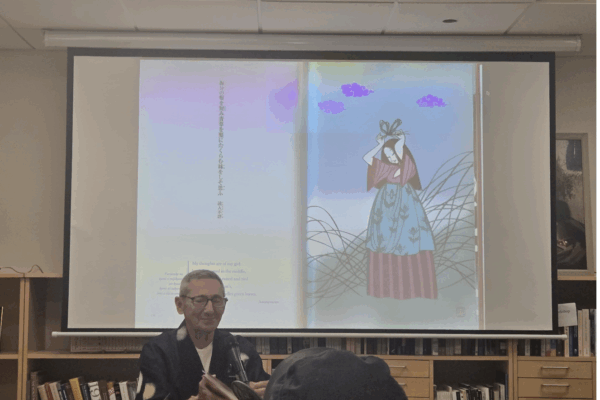
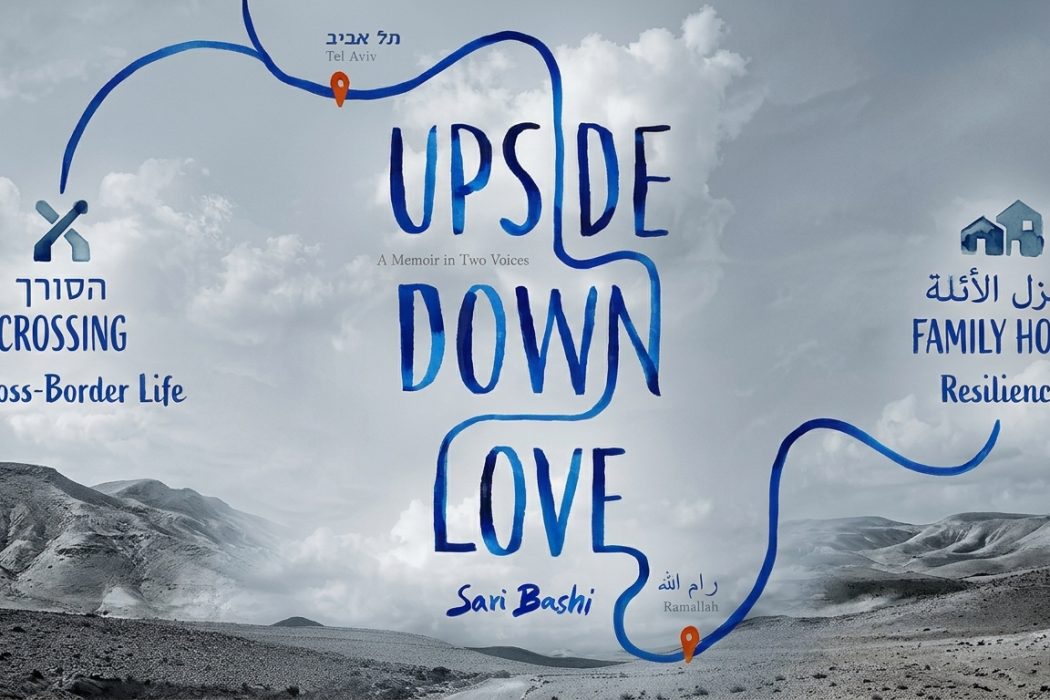
Sari Bashi’s Upside-Down Love. A Memoir in Two Voices — published in 2021 in Israel and in 2026 in the US — is both a political and personal book. A human rights lawyer and activist, Bashi, chronicles this entanglement from the beginning to its heartbreaking final pages. As she describes it, love between Sari and Osama (a pseudonym) resides “outside the bounds of law,” a “non space” where something as difficult as separation becomes a welcomed form of “normality” as it happens between two people the State would rather keep apart. In the book, the relationship is politicized; living in Ramallah is forbidden for Israeli citizens and is seen by the couple as a form of “civil disobedience.” Furthermore, fatherhood for Osama is difficult and tormenting because of the constant discrimination he faces in the eyes of his children. Bashi writes that the book was written to “spark central questions and doubts among a non-existent community of readers, Israeli and Palestinian”. Also, according to Osama, it was written “to share our lives” inside the upside-down world of oppression in Israel-Palestine, “as a way of putting distance between ourselves and our crazy reality”. Finally, the book stands as a testimony that there are “good, loving people who are working for a better future”.
Your book shows in great detail how an oppressive system penetrates (and destroys) personal life. In such a context, is it possible to separate the political from the personal? What relationship do you see between these two spheres?
I think every human being’s personal life is deeply shaped by the political context, but it is not always obvious how. For Osama and me, it’s extremely obvious how the political context shapes and constrains our ability to love each other. So no, they can’t be separated. However, we can all do a better job looking at how this entanglement works. Particularly for Israeli Jews who are in the position to easily ignore it. We have the responsibility to think about it and make better choices. I wrote the book out of a simple personal need. I’m an introvert by nature, so I find it hard to share. Writing makes it easier to share because I can articulate what I want to say in a room by myself in front of a computer. Sharing takes place afterward. In addition, particularly when I fell in love with Osama, the experiences, the feelings, the fears were overwhelming, and I couldn’t really tell anybody. Thus, writing answered a need.
I also have a political motivation in publishing the book. A personal story is a way for people who may be reluctant to learn more about the Israeli occupation, apartheid, and settler colonialism. They can be open to a personal story, and through it, maybe see the context in a less threatening way. One of the most rewarding reactions I got was from an Israeli reader. He wrote to me, “I disagreed with a lot of what you wrote. A lot of what you wrote made me angry. But you showed me something that I hadn’t seen. Thank you”.
In the Israel-Palestine context, the facts are not really disputed, apart from minor issues. However, the narrative around the facts is. Therefore, I tried to tell my narrative about what’s happening here and what needs to happen.
Besides this response, how was the book received in Israel and in the countries where it has been translated (the US, Spain, Italy, etc.)? Is an Arabic translation planned?
It was published in Hebrew in 2021, and I don’t think it would have been published today in Israel. It was a different time back then, not a perfect time, but there was some openness to hearing that kind of story. In the same period, I was also writing a blog in the family section of Haaretz, where I was trying to invite Israeli readers who maybe wouldn’t choose to read about the occupation, but were interested in a mother raising her kids in the West Bank, to read and learn. It was well received in Israel by the few who chose to read it, who are probably already open-minded. I also think people appreciated a window into life in the West Bank and Gaza – and the access to Osama’s voice.
The book came out in other countries – Italy, the Netherlands, the United States, and Spain – after October 7th, 2023. People were interested in learning more about a place that they were hearing about in the news. The feedback that I most appreciated from some of those countries was that it was a window into understanding life there.
I was in Italy in October 2025 for the book tour. It was really beautiful to see how deeply many left-wing Italians identified with Palestinian rights. It was deeply felt, and they explained to me that it had to do in part with the Italian history of resistance to fascism: people identified in a genuine way. When I was there, there were national strikes in solidarity with Gaza, which is an indication of people’s care. I think that in some people, Palestine has sparked a sense of solidarity.
In the United States, I’m getting criticism that the book is not hard enough on Israelis or is not definitive enough in making moral or political judgments. I understand that. But that’s not what I want the book to be. I want it to be a story in front of which people can find their place. I would love to have an Arabic translation. It’s a bit fraught. I think we need a little more time to see how the English version is accepted. As we still live in the region, it is not easy to publish about our lives in a place that is not safe.
In the book, you mention a critique that you received at a conference in Istanbul regarding your legal work with Gisha — which means “access” — an organization founded to support the severely restricted mobility of Palestinians. The critique was that operating within an oppressive system grants it indirect legitimacy. You responded that the concept of “ideological purity” is often less successful than pragmatism in achieving small results. You write that Palestinians live in a state of constant illegality and “perpetual criminality”. Therefore, to what extent do you think it is possible to use Israeli law as a tool for advancing Palestinian freedom and justice? And, do you think the International Criminal Court and the International Court of Justice can have an effective role?
International law is most effectively enforced politically. International courts have no police force, and their value is often in the moral judgment they ratify and in the influence it can have on international politics. Their involvement is very important, and international law should be a compass for deciding what is acceptable and what isn’t in Israel-Palestine. However, only states can enforce judgment, particularly those states allied with the Israeli government — those that fund, arm, and guarantee its political legitimacy. There’s been some really encouraging shifts over the past few years in European and in U.S. public opinion. Within Europe, there have been some small steps, including sanctioning individual violent settlers and stronger statements from European governments. Still, we need more concrete action. But I see it coming, in part because what’s happening in Israel-Palestine is so nakedly unjust and horrific that it’s becoming harder for governments to support it. So I’m optimistic in that sense.
The Israeli legal system is a tool to push things forward: it’s not a tool for justice, but it can help in individual cases. As the years go by, I feel more committed to using Israeli law to do as much good as possible. I understand why people from outside are so concerned with principles, but I believe that if you want to create change, you have to be pragmatic in a principled way. My current job is the director of a human rights NGO called the Public Committee Against Torture. I will take every opportunity to use the legal system to get an extra serving of chicken for a pregnant detainee who needs more protein. This won’t get rid of the occupation or solve the fact that she’s unjustly detained. But maybe her pregnancy will be a little bit healthier. I think it’s important to pay attention to the needs of the people whose rights are being abused, and do what is possible to help them remain resilient.
The complaints of the Palestinian prisoners that you gathered with the Public Committee Against Torture in Israel contributed to Nicholas Kristof’s article in the New York Times on sexual violence against Palestinian detainees, and that led Netanyahu to threaten to sue the NYT. Can you describe the work and the findings of your research?
The organization I lead has been operating for the last 36 years, representing Palestinian political prisoners who are at risk of torture and other forms of cruel, inhumane, or degrading treatment. Torture has been an inherent feature of the occupation. Because of a number of unlawful measures taken by the Israeli government, lawyers are actually the only independent visitors to prisons. In fact, since October 2023, the Israeli government has blocked family visits and the visits of the International Committee of the Red Cross. So when we visit them, we take testimonies regarding abuse, and we file complaints against prison guards, soldiers, or the Israel Security Agency interrogators (Shin Bet). We try to use the complaints to improve their conditions, stop, or at least mitigate the torture. We file petitions with criminal defence lawyers to get the judges to see what’s going on in the prisons. We also do more principled and general work to change the policies that facilitate torture, and to fight against the death penalty, which has been reintroduced into Israeli law only for Palestinians.
Sexual violence has always existed in the treatment of Palestinian detainees, but it’s gotten much worse over the last few years, particularly by prison guards and soldiers. The episodes we observe include rape, threats of rape to the prisoner and the women in their family, forced nudity, being forced to watch pornographic materials, and being hit in the genitals. Sexual violence is always underreported, and if I look at our records from the last decades, there’s some information about it, but it is taboo. Now, detainees begin to talk about it.
The highest authorities know that this is happening. In a very famous case in 2024, soldiers in Sde Teiman were filmed sexually abusing a detainee so brutally that he had to be hospitalized. The doctors reported the occurrence, and the military authorities, who never open investigations, were forced to take action. The political backlash against the investigation of the soldiers’ abuse was so tremendous that Yifat Tomer-Yerushalm, the military advocate general who opened the case, was fired and herself put under criminal investigation. The new military advocate general, Itai Ofir, in March 2026 dropped all charges against the five soldiers.
At one point, Osama writes that he used to equate the Israeli power repressing him with Jewish people in general, but later realized that conflating the two was an unwarranted generalization. He notes that a clearer understanding of the distinction between political oppression and Jewish identity can strengthen the possibilities for Palestinian emancipation. What are your thoughts on the debate surrounding so-called “normalization” — the criticism that many forms of cooperation between Israeli Jews and Palestinians are merely formal disguises for power asymmetries — which you also reference in the book?
There are reasons to be very deliberate and cautious in the ways that Israelis and Palestinians work together. There’s a toxic history of joint work being imposed on Palestinians in ways that presumed symmetry, without taking into account the overwhelming power imbalance between Israelis and Palestinians. We must find principled ways to engage in co-resistance, and that’s hard. But we need it if we’re actually going to achieve liberation. A majority of Israeli Jews are not going to voluntarily give up their privilege; in very few societies does this happen. Yet, some of us are. We should be cultivating a small but important group of Israeli Jews who oppose the current regime and their allies.
Osama states that “those who think that people learn from history are stupid, insanely stupid”, referring to both Palestinians and Israeli Jews. Unsurprisingly, security concerns are the primary justification used to mobilize discrimination against Palestinians. How does the Jewish experience of the Nazi fascist persecution intersect with this dynamic?
One of the painful aspects of what’s happening in Israel-Palestine is that the Holocaust is evoked to justify the idea that Jewish safety depends on Jews having total power. Many people survived the Holocaust with a commitment to the universality of human rights, the sanctity of human life, and the fight against oppression. After World War II, the creation of national and international legal frameworks to constrain power and protect everyone has been a fundamental effort —as imperfect as it may be. However, the Israeli national narrative frames the Holocaust as something highly specific and unique against the Jewish people. Every genocide is unique and specific, and at the same time it has something in common with every other. My wish is that Holocaust researchers and those teaching Jewish history will do a better job situating the Holocaust as a devastating example of racism, dehumanization, and abuse of power. And that they then commit to fighting these phenomena, no matter who is in power, or who is the victim. The Palestinian authorities haven’t learnt their lesson either. Working at Human Rights Watch, I oversaw numerous research projects and publications about abuses by Hamas authorities and the Palestinian Authority (PA). People don’t necessarily learn from being oppressed. They often take the torture they endured on their own bodies and inflict it on somebody else when they can.
You also write that both Israeli and Palestinian societies place fewer expectations on girls than on boys to embody nationalist values, including through the use of violence. Could you elaborate on this?
In Israel, both young men and young women are recruited into the army, but it’s easier for women to get out of it. Further, the myth of the military hero is more commonly applied to men. In that sense, girls are more protected. My friends who’ve left Israel mostly did so to protect their sons from being drafted. On the Palestinian side, the militarism is not as bad, but there is an expectation that boys will embody national ideologies more, and in some cases will use violence to resist occupation. Both societies are patriarchal in different ways.
Do you think there is also a reproductive dimension to this nationalist and patriarchal ideology, concerning, for instance, the role of women in producing more bodies for the national groups on both sides in the “demographic battle”?
Certainly, the role of mothers in the narrative of fallen soldiers is that of raising men who will then join the Israeli military and then sacrificing them for the national good. On the Palestinian side, when young men are killed, the parents, especially the mothers, are given the status of a martyrs’ mother. Within Israel, there’s a demographic battle, an ethnic cleansing, where Palestinians are just being removed, forcibly displaced, or killed. There are also policies to encourage births: you receive a larger child allowance if you have many children. The state does this to encourage Jewish births. On the Palestinian side, women are often relegated to the role of mothers and homemakers, so there could be an expectation that raising children is a woman’s job. In both cases, patriarchy serves a national ideology.
In the final pages of the new English afterword, written in July 2005, you write of a “time of unspeakable violence, destruction, and loss in Israel-Palestine, particularly in Gaza”, of an increasingly militarized Israeli society and of settler crimes against Palestinians backed by the Israeli government. At one point, Osama writes that the fragmentation of legal statuses among Palestinians in Gaza, the West Bank, and inside Israel undermines internal solidarity among Palestinians themselves. He describes how minor privileges sow division among those who have suffered and continue to suffer injustice — such as the Druze, Arab Jews, and Palestinians. What processes do you believe are necessary to achieve peace and justice for the 14 million people living in Israel-Palestine? Do you see possibilities of change? Which sectors of society or organs of the state do you consider more likely to undertake a process of transformation?
The Primo Levi Center is based in the United States, so it’s important for me to say that people in the US have a lot of leverage. The U.S. must end its complicity in the horrific abuses happening in Israel-Palestine. Once that happens, things here will change very quickly, because the Israeli regime depends on U.S. and European backing. That’s on folks in the U.S. and Europe. There are many good initiatives. An active group called the One Democratic State Campaign, a very difficult initiative given the current situation, is working to realize a society of people living together in this land, in genuine equality, security and justice.
Within Israeli society, there is a small but important number of people who are starting to ask fundamental questions about the regime, and also realizing that the problem is not just this government or a specific policy, but rather a system of government based on Jewish supremacy over Palestinians. So these people are tremendous allies, and there are initiatives like the Mizrahi Civic Collective, a group of Arab Jews, coming together around issues of social justice and genuine democracy in a way that I see as a decolonial process. Zionism colonized not just Palestinians, but also Arab Jews. In degrading the Arabic language and the Arabic identity, Palestinians were the most harmed, but Jews from Arab lands were also affected. Thus, uncovering and celebrating what was suppressed also contributes to liberation.
Given all the power imbalances, and given your role and position as an Israeli, what do you think should happen regarding the situation in Palestine?
The movement for Palestinian liberation needs to be Palestinian-led. However, being in leadership is challenging because every time people try to organize and mobilize people around justice, democracy, or criticism, they are suppressed either by Hamas, or the Palestinian Authority, or by the Israeli government. Some initiatives are trying to organize around a different kind of resistance, one that maybe has a better prospect for liberation, and it’s difficult due to the separation, the fragmentation, and the violence.
The Israeli government is also arresting a lot of people for doing things like providing free medical care because that’s seen as strengthening society’s resilience. For example, the Israeli government designated as unlawful an organization that was providing free medical care in the West Bank. They then arrested people involved in it, including a physician in Ramallah who gave free or reduced-price medical care to anybody who needed it out of commitment to providing for people. He’s 71 years old, and he’s currently being tortured in prison. His arrest was not accidental. The Israeli government arrests people who show leadership and promise and actually help people. If not by the Israeli government, many of these initiatives are repressed by Hamas or the Palestinian Authority.