The history of Judaism in Puglia offers a compelling example of how Mediterranean cultures are shaped by mobility, textual and custom exchange, and networks connecting distant communities.
Puglia is not merely a geographical crossroads between the Italian peninsula, the Balkans, and the eastern Mediterranean; it is, as it was in the past, an active node in the circulation of people, knowledge, religious traditions, and commercial practices.
Apulian Jews were an integral part of local communities and participated in transregional networks, mediated between different cultural environments, and transmitted traditions that continued to develop long after their original bearers had migrated elsewhere.
Jewish communities appear to have settled in Puglia as early as the first century CE, and archaeological evidence confirms their presence during the Roman imperial period.
The region’s Adriatic ports facilitated connections with the Land of Israel, the Byzantine Empire, and North Africa. Apulian Jews participated in extensive commercial networks, particularly in the textile trade.
Their knowledge of Greek, Latin, and local vernaculars enabled them to mediate between different linguistic and cultural environments. Commerce, multilingualism, and geographical mobility thus provided the foundations for a Jewish presence deeply integrated into the wider Mediterranean world.
But this is not the whole story. Puglia has also been a pulsing center of Jewish intellectual life and has influenced what we today call European Judaism in ways that are seldom understood.
During the early Middle Ages, its Jewish academies attracted scholars from Baghdad to Jerusalem, and its rabbis acquired recognition throughout the Jewish world. In the twelfth century, the French Tosafist Rabbeinu Tam praised the scholarship of Bari and Otranto by adapting Isaiah 2:3: “For from Bari shall come forth Torah, and the word of the Lord from Otranto.”
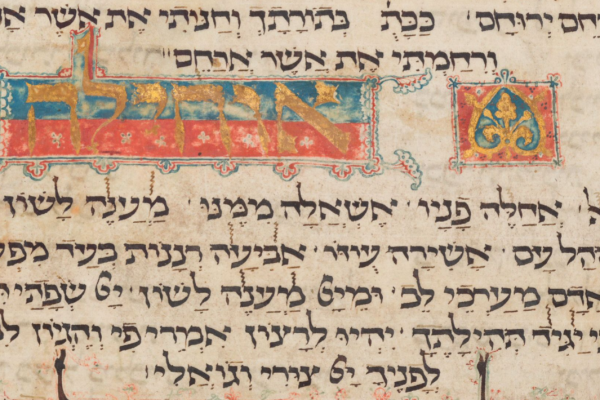
This testimony places Apulian learning within a transregional intellectual network in which scholarly authority circulated across considerable distances. Manuscripts from Otranto, containing Italian annotations written in Hebrew characters alongside Hebrew and Aramaic texts, further reveal how Jewish scholarship engaged with the linguistic environment of southern Italy. Apulia was therefore not simply a recipient of traditions originating elsewhere: it was a centre of learning whose scholars and textual practices contributed to the wider circulation of Jewish knowledge.
The same pattern emerges from traditions concerning migration. A medieval legend recounts how four rabbis departed from Bari and were captured by pirates leading them to the coasts of North Africa. They negotiated their way to establishing houses of Jewish learning in Tunisia, Egypt, Iberia, and, eventually, Provence. Although legendary in form, the narrative expresses a fundamental principle of diaspora history: the movement of individuals could generate new intellectual centres and extend existing networks across the Mediterranean.
Similarly, traditions associated with the Kalonymos family connect Byzantine and southern Italian Jewry with northern Italy and the Rhineland, where members of the family were linked to the intellectual and mystical culture of the Hasidei Ashkenaz.
Apulian Judaism was itself transformed by successive movements of people arriving from the Balkans, northern Italy, France, Spain, and Portugal. These encounters shaped local religious practices, including the distinctive southern Italian liturgical rite.
The expulsion of Jews from southern Italy under Spanish rule, during the late fifteenth and early sixteenth centuries, radically altered this cultural landscape. Many migrated to Venice, Corfu, the Balkans, and Ottoman cities, particularly Salonika.
These movements did not simply bring an end to Apulian Jewish life: they redistributed its traditions across the Mediterranean, where they interacted with other Jewish identities and continued to evolve. The preservation of southern Italian liturgical practices in Corfu and their subsequent documentation in prayer books published in Venice illustrate this process. Manuscripts, liturgical texts, and traces of Judeo-Italian dialects demonstrate how religious and linguistic traditions survived through migration and adaptation. They also reveal an essential feature of cultural memory: the history of a community may be preserved not in the place where it originated, but in the distant communities to which its members migrated. The disappearance of Jewish communal life from Apulia therefore did not entail the disappearance of its cultural legacy.
The 20th century brought new surprises to Puglia, including the mass conversion to Judaism of the entire town of San Nicandro, which had reconstructed a Jewish way of life based on the Biblical text and eventually moved to Israel en masse in 1948.
The arrival of large number of Jewish Holocaust survivors and displaced persons in Apulia between 1944 and 1948 further underscores the region’s continuing role in Mediterranean history. Transit camps became temporary centres of education, Hebrew instruction, communal reconstruction, and preparation for migration. Inscriptions, marriage documents, photographs, memoirs, and artworks preserve traces of these experiences, connecting Apulia with the international networks of Jewish relief and the postwar movement towards Israel, the US, and South America.
This principle remains relevant to the contemporary rediscovery of Apulian Judaism. In Trani, the restoration of medieval synagogues and the establishment of a museum, as well as the opening of a Jewish museum in Lecce, on the site of the fifteenth-century synagogue, have reconnected surviving buildings and objects with the history of communities whose heritage extends far beyond the region.
The re-establishment of Jewish communal life also demonstrates how historical memory can become a resource for renewed cultural and religious identification.
After 2000 years since the first settlement of Jewish communities in Apulia, the region has become once again a meeting point where people from different places rebuild communal ties and forge new trajectories of Jewish life.